


Page 76 - (DK Eyewitness) Travel Guide - Spain
P. 76
74 INTRODUCING SP AIN
Rulers of Spain
1665–1700
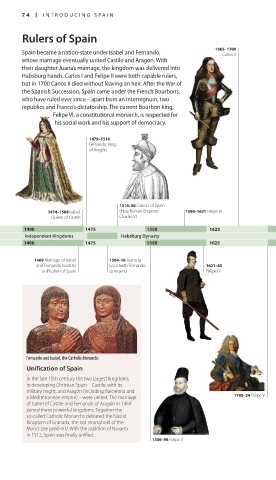
Spain became a nation-state under Isabel and Fernando, Carlos II
whose marriage eventually united Castile and Aragón. With
their daughter Juana’s marriage, the kingdom was delivered into
Habsburg hands. Carlos I and Felipe II were both capable rulers,
but in 1700 Carlos II died without leaving an heir. After the War of
the Spanish Succession, Spain came under the French Bourbons,
who have ruled ever since – apart from an interregnum, two
republics and Franco’s dictatorship. The current Bourbon king,
Felipe VI, a constitutional monarch, is respected for
his social work and his support of democracy.
1479–1516
Fernando, King
of Aragón
1516–56 Carlos I of Spain
1474–1504 Isabel, (Holy Roman Emperor 1598–1621 Felipe III
Queen of Castile Charles V)
1400 1475 1550 1625
Independent Kingdoms Habsburg Dynasty
1400 1475 1550 1625
1469 Marriage of Isabel 1504–16 Juana la
and Fernando leads to Loca (with Fernando 1621–65
unification of Spain as regent) Felipe IV
Fernando and Isabel, the Catholic Monarchs
Unification of Spain
In the late 15th century the two largest king doms
in developing Christian Spain – Castile, with its
military might, and Aragón (including Barcelona and
a Mediterranean empire) – were united. The marriage 1700–24 Felipe V
of Isabel of Castile and Fernando of Aragón in 1469
joined these powerful kingdoms. Together the
so-called Catholic Monarchs defeated the Nasrid
Kingdom of Granada, the last stronghold of the
Moors (see pp60–61). With the addition of Navarra
in 1512, Spain was finally unified.
1556–98 Felipe II
074-075_EW_Spain.indd 74 26/09/17 11:52 am

