


Page 96 - (DK Eyewitness) Travel Guide - Spain
P. 96
94 NOR THERN SP AIN
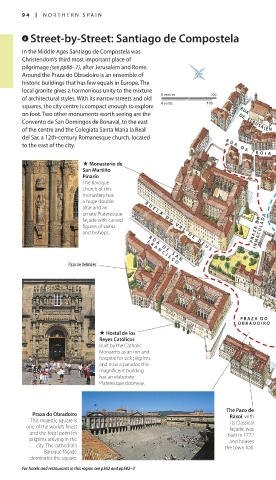
6 Street-by-Street: Santiago de Compostela
In the Middle Ages Santiago de Compostela was
Christendom’s third most important place of
pilgrimage (see pp86–7), after Jerusalem and Rome.
Around the Praza do Obradoiro is an ensemble of
historic buildings that has few equals in Europe. The
local granite gives a harmonious unity to the mixture 0 metres 100
of architectural styles. With its narrow streets and old 100
squares, the city centre is compact enough to explore 0 yards RÚA
on foot. Two other monu ments worth seeing are the
Convento de San Domingos de Bonaval, to the east DE XERUSALÉN
of the centre and the Colegiata Santa Maria la Real
del Sar, a 12th-century Romanesque church, located
to the east of the city. R Ú A D A T R O I A RÚA DE ACEVECHERIA
. Monasterio de
San Martiño
Pinario
The Baroque V Í A S A C R A
church of this
monastery has
a huge double
altar and an
ornate Plater esque
façade with carved
figures of saints R U E L A D O V A L D E D E U S
and bishops. P R A Z A D A I N M A C U L A D A
R Ú A D E S A N
Pazo de Xelmírez F R A N C I S C O
PR A Z A DO
OBR ADOIRO
. Hostal de los
Reyes Católicos
Built by the Catholic
Monarchs as an inn and
hospital for sick pilgrims,
and now a parador, this
magnificent building
has an elaborate
Plateresque doorway.
The Pazo de
Praza do Obradoiro Raxoi, with
This majestic square is its Classical
one of the world’s finest façade, was
and the focal point for built in 1772
pilgrims arriving in the and houses
city. The cathedral’s the town hall.
Baroque façade
dominates the square.
For hotels and restaurants in this region see p562 and pp582–3
094-095_EW_Spain.indd 94 26/09/17 11:00 am

