


Page 91 - (DK Eyewitness) Travel Guide - Spain
P. 91
NOR THERN SP AIN 89
GALICIA
Lugo • A Coruña • Pontevedra • Ourense
Remotely located in the northwest corner of the peninsula,
Galicia is the country’s greenest region. It is also Spain’s
main seafaring region – three of its four provinces have
an Atlantic coast line, and its cuisine is based around superb
seafood. The inland villages maintain a slow and relaxed
pace of life, with many locals growing their own vegetables
and keeping small farmyard animals.
The Galicians, whose origins are Celtic, Compostela as Europe’s most impor tant
are fiercely proud of their culture and religious shrine after St Peter’s in Rome.
language. The region’s official language, Every year, hundreds of pilgrims and
used on most signs, is Gallego. It has tourists still follow this ancient route
similarities to the language of Portugal, of pilgrimage across Northern Spain.
which borders Galicia to the south. The The Galician coast is characterized by
Celtic character of this haunting land is impressive cliffs, islands and fjord-like
still evident in the Galicians’ favourite rías; the loveliest of these are the Rías
tra ditional instrument, the bagpipes, and Baixas in the west. Elsewhere it juts
much of Galicia still has a medieval quality. defiantly into the Atlantic in rocky
The misty, emerald countryside abounds headlands, such as Cabo Fisterra, Spain’s
with old granite villages and is dotted with most westerly point. Many people still
pazos – traditional stone manor houses. make a living from the sea, whether in
The discovery of the supposed tomb of the fishing or ship -building industry and
St James the Apostle, in the 9th century, Vigo, in Pontevedra, is the most important
confirmed medieval Santiago de fishing port in Spain.
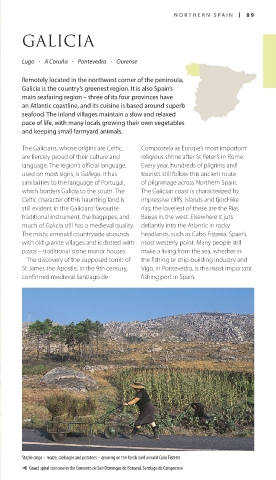
Staple crops – maize, cabbages and potatoes – growing on the harsh land around Cabo Fisterra
Grand spiral staircase in the Convento de San Domingos de Bonaval, Santiago de Compostela
088-089_EW_Spain.indd 89 26/09/17 11:53 am

