


Page 33 - All About History - Issue 70-18
P. 33
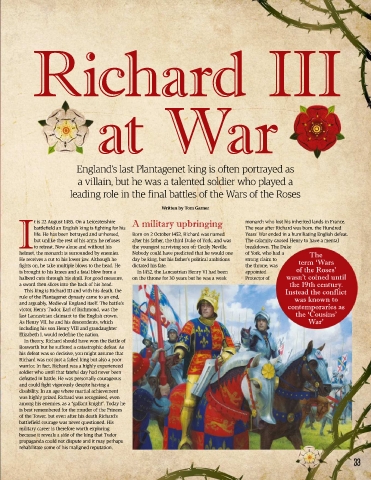
Richard                                                                                                          III


                                               at                               War


                                      England’s last Plantagenet king is often portrayed as


                                      a villain, but he was a talented soldier who played a


                                   leading role in the final battles of the Wars of the Roses


                                                                               Written by Tom Garner


          I      t is 22 August 1485. On a Leicestershire       A military upbringing                                  monarch who lost his inherited lands in  France.
                                              fighting
                                                       for his
                 battlefield
                                                                                                                                after Richard was born, the Hundred
                                            is
                               English king
                                                                                                                       The year
                            an
                                   betrayed
                                            and unhorsed,
                                                                Born on 2 October 1452, Richard was named
                 life. He has been
                                                                                                                       Years’ War ended in a humiliating English defeat.
                                                                after his father, the third Duke of York, and was
                                                                                                                                                     have
                                                                                                                                                           a mental
                 but unlike the rest of his army he refuses
                                                                                                                       The calamity
                                                                                                                                    caused
                                                                                                                                            Henry to
                    retreat. Now alone and without his
                 to
                                                                                                   he would one
                                                                                                                       of York, who had a
          helmet, the monarch is  surrounded by enemies.        the youngest surviving son ofr Cecily Neville.         breakdown.  The Duke          The
                                                                Nobody could have
                                                                                    predicted that
          He receives a cut to  his lower jaw.  Although he     day be king, but his father’s political ambitions      strong  claim to
          fights  on, he take  multiple blows to  the head. He  dictated his fate.                                     the throne, was          term ‘Wars
          is brought to his knees and a fatal blow from a          In  1452, the Lancastrian Henry VI  had been        appointed               of the Roses’
          halberd cuts through his skull. For good measure,     on the throne for 30 years but he was a weak           Protector of       wasn’t coined until
          a sword then  slices  into  the back  of his head.                                                                                the 19th century.
             This king is Richard III and with his death, the                                                                             Instead the conflict
          rule of the Plantagenet dynasty came to  an  end,                                                                                   was known to
          and arguably, Medieval  England itself. The battle’s
          victor, Henry Tudor, Earl  of Richmond, was the                                                                                  contemporaries as
          last Lancastrian claimant  to  the English crown.                                                                                    the ‘Cousins’
          As  Henry VII,  he and his descendents,  which                                                                                             War’
          including his son Henry VIII  and grandaughter
          Elizabeth I,  would redefine the nation.
             In  theory, Richard should  have  won the Battle of
          Bosworth but he suffered a catastrophic defeat. As
          his defeat was so decisive, you might assume that
          Richard was not just a failed king but also a poor
          warrior. In fact, Richard was a highly experienced
          soldier who until that  fateful day had never been
          defeated in battle. He was personally courageous
          and could fight vigorously despite having  a
          disability. In  an  age where martial achievement
          was highly prized Richard was recognised, even
          among his enemies,   as  a “gallant  knight”.  Today he
          is best remembered for the murder of the Princes
          of the Tower, but even after his death Richard’s
          battlefield courage was never questioned. His
          military  career  is  therefore worth exploring
          because it reveals a side of the king that Tudor
          propaganda   could not dispute and it  may perhaps
          rehabilitate some of his maligned reputation.


                                                                                                                                                                           33

