


Page 38 - All About History - Issue 70-18
P. 38
Wars of the Roses
The Battle of Tewkesbury was a
decisive engagement
The captive Henry VI officially died that night of
“melancholy” but it is more likely that Edward
ordered him to be murdered. It is unknown what
Richard’s direct involvement in Henry’s death was,
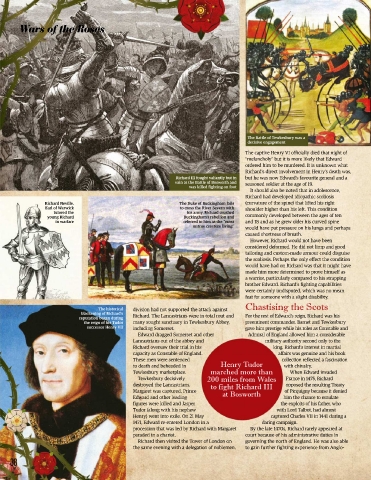
Richard III fought valiantly but in but he was now Edward’s favourite general and a
vain at the Battle of Bosworth and seasoned soldier at the age of 19.
was killed fighting on foot
It should also be noted that in adolescence,
Richard had developed idiopathic scoliosis
Richard Neville, The Duke of Buckingham fails (curvature of the spine) that lifted his right
Earl of Warwick to cross the River Severn with shoulder higher than his left. This condition
tutored the his army. Richard crushed
young Richard Buckingham’s rebellion and commonly developed between the ages of ten
in warfare referred to him as the “most and 18 and as he grew older his curved spine
untrue creature living” would have put pressure on his lungs and perhaps
caused shortness of breath.
However, Richard would not have been
considered deformed. He did not limp and good
tailoring and custom-made armour could disguise
the scoliosis. Perhaps the only effect the condition
would have had on Richard was that it might have
made him more determined to prove himself as
a warrior, particularly compared to his strapping
brother Edward. Richard’s fighting capabilities
were certainly undisputed, which was no mean
feat for someone with a slight disability.
Chastising the Scots
The historical division had not supported the attack against
blackening of Richard’s Richard. The Lancastrians were in total rout and For the rest of Edward’s reign, Richard was his
reputation began during
the reign of his Tudor many sought sanctuary in Tewkesbury Abbey, preeminent commander. Barnet and Tewkesbury
successor Henry VII including Somerset. gave him prestige while his roles as Constable and
Edward dragged Somerset and other Admiral of England allowed him a considerable
Lancastrians out of the abbey and military authority second only to the
Richard oversaw their trial in his king. Richard’s interest in martial
capacity as Constable of England. affairs was genuine and his book
These men were sentenced collection reflected a fascination
to death and beheaded in Henry Tudor with chivalry.
Tewkesbury marketplace. marched more than When Edward invaded
Tewkesbury decisively 200 miles from Wales France in 1475, Richard
destroyed the Lancastrians. to fight Richard III opposed the resulting Treaty
Margaret was captured, Prince of Picquigny because it denied
Edward and other leading at Bosworth him the chance to emulate
figures were killed and Jasper the exploits of his father, who
Tudor (along with his nephew with Lord Talbot, had almost
Henry) went into exile. On 21 May captured Charles VII in 1441 during a
1471, Edward re-entered London in a daring campaign.
procession that was led by Richard with Margaret By the late 1470s, Richard rarely appeared at
paraded in a chariot. court because of his administrative duties in
Richard then visited the Tower of London on governing the north of England. He was also able
the same evening with a delegation of noblemen. to gain further fighting experience from Anglo-
38

