


Page 24 - Dog
P. 24
Leader of the pack


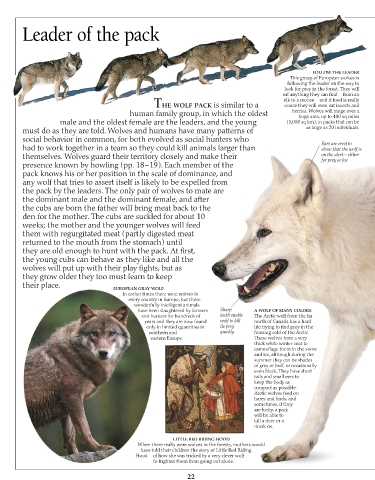
                                                                                                       FOLLOW THE LEADER
                                                                                                This group of European wolves is
                                                                                               following the leader on the way to
                                                                                              look for prey in the forest. They will
                                                                                             eat anything they can find – from an
                                                                                              elk to a mouse – and if food is really
                                                   The wolf pack is similar to a              scarce they will even eat insects and
                                           human family group, in which the oldest              berries. Wolves will range over a
                                                                                                  huge area, up to 400 sq miles
                     male and the oldest female are the leaders, and the young                 (1,000 sq km), in packs that can be
        must do as they are told. Wolves and humans have many patterns of                            as large as 20 individuals.
        social behavior in common, for both evolved as social hunters who
        had to work together in a team so they could kill animals larger than                             Ears are erect to
                                                                                                          show that the wolf is
        themselves. Wolves guard their territory closely and make their                                   on the alert – either
                                                                                                          for prey or foe
        presence known by howling (pp. 18–19). Each member of the
        pack knows his or her position in the scale of dominance, and
        any wolf that tries to assert itself is likely to be expelled from
        the pack by the leaders. The only pair of wolves to mate are
        the dominant male and the dominant female, and after
        the cubs are born the father will bring meat back to the
        den for the mother. The cubs are suckled for about 10
        weeks; the mother and the younger wolves will feed
        them with regurgitated meat (partly digested meat
        returned to the mouth from the stomach) until
        they are old enough to hunt with the pack. At first,
        the young cubs can behave as they like and all the
        wolves will put up with their play fights, but as
        they grow older they too must learn to keep
        their place.
                                      EUROPEAN GRAY WOLF
                                         In earlier times there were wolves in
                                           every country in Europe, but these
                                             wonderfully intelligent animals
                                              have been slaughtered by farmers   Sharp   A WOLF OF MANY COLORS
                                               and hunters for hundreds of   teeth enable   The Arctic wolf from the far
                                                years and they are now found   wolf to kill   north of Canada has a hard
                                                 only in limited quantities in   its prey   life trying to find prey in the
                                                  southern and           quickly    freezing cold of the Arctic.
                                                  eastern Europe.                   These wolves have a very
                                                                                    thick white winter coat to
                                                                                    camouflage them in the snow
                                                                                    and ice, although during the
                                                                                    summer they can be shades
                                                                                    of gray or buff, or occasionally
                                                                                    even black. They have short
                                                                                    tails and small ears to
                                                                                    keep the body as
                                                                                    compact as possible.
                                                                                    Arctic wolves feed on
                                                                                    hares and birds, and
                                                                                    sometimes, if they
                                                                                    are lucky, a pack
                                                                                    will be able to
                                                                                    kill a deer or a
                                                                                    musk ox.

                                                          LITTLE RED RIDING HOOD
                                              When there really were wolves in the forests, mothers would
                                               have told their children the story of Little Red Riding
                                             Hood – of how she was tricked by a very clever wolf –
                                                   to frighten them from going out alone.

                                                              22
                                            (c) 2011 Dorling Kindersley. All Rights Reserved.

