


Page 20 - Dog
P. 20
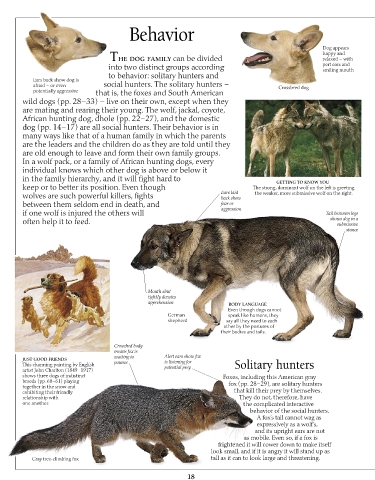
Behavior


                                                                                                          Dog appears
                                                                                                          happy and
                                     The dog family can be divided                                        relaxed – with
                                    into two distinct groups according                                    pert ears and
                                                                                                          smiling mouth
                                    to behavior: solitary hunters and
            Ears back show dog is
            afraid – or even       social hunters. The solitary hunters –                   Crossbred dog
            potentially aggressive  that is, the foxes and South American
        wild dogs (pp. 28–33) – live on their own, except when they
        are mating and rearing their young. The wolf, jackal, coyote,
        African hunting dog, dhole (pp. 22–27), and the domestic
        dog (pp. 14–17) are all social hunters. Their behavior is in
        many ways like that of a human family in which the parents
        are the leaders and the children do as they are told until they
        are old enough to leave and form their own family groups.
        In a wolf pack, or a family of African hunting dogs, every
        individual knows which other dog is above or below it
        in the family hierarchy, and it will fight hard to                                 GETTING TO KNOW YOU
        keep or to better its position. Even though                                 The strong, dominant wolf on the left is greeting
        wolves are such powerful killers, fights                         Ears laid   the weaker, more submissive wolf on the right.
                                                                         back show
        between them seldom end in death, and                            fear or
        if one wolf is injured the others will                           aggression                        Tail between legs
        often help it to feed.                                                                               shows dog in a
                                                                                                               submissive
                                                                                                                  stance


                                                 Mouth shut
                                                 tightly denotes
                                                 apprehension               BODY LANGUAGE
                                                                           Even though dogs cannot
                                                        German             speak like humans, they
                                                        shepherd           say all they need to each
                                                                          other by the postures of
                                                                         their bodies and tails.

                                      Crouched body
                                      means fox is
                                      waiting to       Alert ears show fox
        JUST GOOD FRIENDS                              is listening for
        This charming painting by English   pounce     potential prey         Solitary hunters
        artist John Charlton (1849–1917)
        shows three dogs of indistinct                                    Foxes, including this American gray
        breeds (pp. 60–61) playing                                          fox (pp. 28–29), are solitary hunters
        together in the snow and
        exhibiting their friendly                                            that kill their prey by themselves.
        relationship with                                                      They do not, therefore, have
        one another.                                                            the complicated interactive
                                                                                   behavior of the social hunters.
                                                                                     A fox’s tail cannot wag as
                                                                                     expressively as a wolf’s,
                                                                                    and its upright ears are not
                                                                                 as mobile. Even so, if a fox is
                                                                        frightened it will cower down to make itself
                                                                      look small, and if it is angry it will stand up as
           Gray tree-climbing fox                                     tall as it can to look large and threatening.

                                                              1
                                            (c) 2011 Dorling Kindersley. All Rights Reserved.

