


Page 160 - (DK) Smithsinian - Military History: The Definitive Visual Guide to the Objects of Warfare
P. 160
INTRODUCTION


            From the late 17th to the early 19th centuries,               From the second half of the 18th century, a new spirit
            there were few dramatic changes in military                   infused European warfare, related to the currents of
            technology. The basic infantry weapon was the                 revolution that swept America in the 1770s, and France
            flintlock musket with bayonet attached; artillery             from 1789. Although the American Revolution, waged by
            consisted of smoothbore muzzle-loading cannon.  America against Britain, was fought mostly by conventional
            However, the nature of warfare developed in                   armies, irregular troops with rifles showed their effectiveness.
            organization, ideology, strategy, and tactics.                This encouraged European armies to make better use
                                                                          of skirmishers as an adjunct to their line infantry, and to
            Eighteenth-century European states maintained permanent       arm some of their forces with rifles. In 1793, the French
            armies commanded by officers, with regiments and formal       revolutionary government created a mass national army,
            hierarchies of rank. Infantry were uniformed and issued       based on the idea that men should fight due to patriotic
            with standard equipment, harshly disciplined, and drilled     enthusiasm, rather than fear of punishment. After rising
            to march and fight in formation with automatic obedience.     to power in 1799, Napoleon Bonaparte reorganized the
            Cavalry performed a variety of roles, from reconnaissance     French army into a unified force of four corps, each capable
            to charges or pursuit of the enemy, while field artillery     of independent operations. Like the British Royal Navy’s
            was also now a key part of armies. At sea, a ship of the      Admiral Nelson, at sea Napoleon favored an offensive
            line might mount 70–130 cannon in broadside. Thus,            strategy and aggressive tactics. By 1815, European armies
            non-European states, such as Ottoman Turkey or Indian         had grown to unprecedented size and states had shown
            princedoms, found themselves at a military disadvantage.      an ability to mobilize vast resources for victory in war.


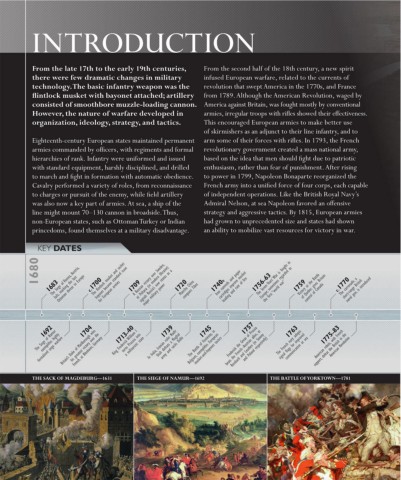
              KEY DATES
              1680                The flintlock musket and socket   A Russian victory over Sweden,    The Seven Years’ War is fought in
                                                  at Poltava (in modern Ukraine)
                                   bayonet become standard issue
                   The Siege of Vienna, Austria,
                                                                                              Europe; sometimes regarded as
                                                                               cartridges improve musket
                                                                              Iron ramrods and paper
                                                                                                            Victory at the Battle
                                                                                                             of Quebec gives Britain
                     fails, marking the last
                                                                                                                           The carronade, a
                                                                                                                             naval gun, is introduced
                                                                                                                            short-range British
                                                                 Manchu China
                                                                                               the first “world war”
                                     for European armies
                  1683  Ottoman threat to Europe   c.1700   1709  signals Russia’s new status as a   1720   1740s  loading and rate of fire  1756–63   1759  control of Canada  c.1770
                                                    major military power
                                                                   conquers Tibet
                                                                                        1757
                                                                                  Frederick the Great of Prussia
                                                                         1745
                1692
                              1704
                                                           1739
                                                                                                                    1775–83
                                                                                                        1763
                                           1713–40
                                                                                                                  American rebels, with French
              The Siege of Namur        Britain’s Duke of Marlborough wins         King Frederick William I         In India, Iranian ruler Nadir         Belgium, exemplifies European   beats the French–Austrian allies, at          The French navy adopts      support, defeat the British in the
                                                                     The Battle of Fontenoy, in
                exemplifies highly
                                                                                                     signal flags for improved
                           his greatest victory over the
                                             turns Prussia into
                                                         Shah defeats a Mughal
                                                                                    Rossbach and Leuthen (in Saxony
                                                           army and sacks Delhi
               formalized siege warfare
                                                                                                                       American Revolution
                                                                                        and Poland respectively)
                                              a militaristic state
                                                                       musket-and-bayonet tactics
                           French, at Blenheim, Germany
                                                                                                       communication at sea
            THE SACK OF MAGDEBURG—1631            THE SIEGE OF NAMUR—1692                        THE BATTLE OF YORKTOWN—1781

