


Page 162 - (DK) Smithsinian - Military History: The Definitive Visual Guide to the Objects of Warfare
P. 162
160      KEY FIGURE                 KEY DEVELOPMENT

         ONET 1680–1815   FREDERICK      18TH-CENTURY


              THE GREAT
              1740–86
                                         UNIFORMED ARMIES
              Frederick the Great (Frederick II,
              King of Prussia) was the most
              admired commander of his time.
              His greatest battles were at Rossbach
              December, 1757, during the Seven
                                         (1701–14) and Austrian Succession (1740–48), the Seven Years’ War (1756–63),
              Years’ War. He won each victory
                                         and the American Revolutionary War (1775–83), followed the tradition of
         Y    and Leuthen, in November and   The armies that fought such conflicts as the wars of the Spanish Succession
              against far larger forces, through
         AND BA                          Permanent regiments, identified by banners,    Alongside the line infantry, European armies
              aggressive battlefield maneuvers.
                                         uniformed regular forces, with a formal hierarchy of ranks.
                                         uniforms, and other symbols, provided a focus
                                                                                        deployed light infantry, who were supposed to take
                                         for loyalty. Cavalry retained high status and were
                                                                                        on a freer role. Some of these light troops, notably
         FLINTLOCK                       reconnaissance and raids, while heavy cavalry were   rifles. Line infantry were not trained in aimed fire,
                                         given important tasks: light horsemen carried out
                                                                                        the Austrian and Prussian Jäger, were armed with
                                         used in field battles to charge with sabres drawn.
                                                                                        which was hardly possible with the inherently
                                         Although field artillery was growing in use, muzzle-
                                                                                        inaccurate smoothbore musket. The Jäger were
                                                                                        accomplished sharpshooters, however, capable
                                         loaded smoothbore cannon as yet played only a
                                         supporting role. Consequently, the success or failure  of accurate sniping and skilled in the use of cover.
                                                                                        Elsewhere, rifle-armed American frontiersmen
                                         of an army depended mainly upon its infantry.
                                                                                        gained a legendary reputation for success against the
                                         MUSKETS AND RIFLES                             British Army in the American Revolutionary War,
                                         Around the start of the 18th century, European   although the reality was not as clearly defined.
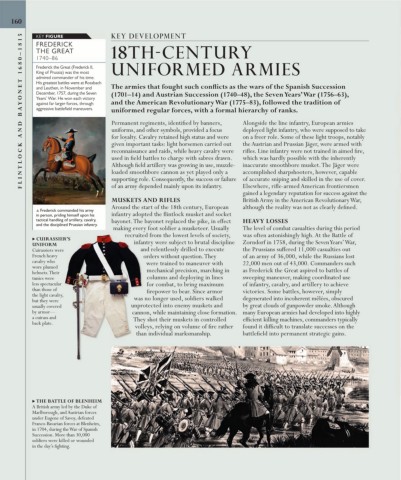
              ▲ Frederick commanded his army
              in person, priding himself upon his   infantry adopted the flintlock musket and socket
              tactical handling of artillery, cavalry,   bayonet. The bayonet replaced the pike, in effect   HEAVY LOSSES
              and the disciplined Prussian infantry.
                                         making every foot soldier a musketeer. Usually   The level of combat casualties during this period
                                             recruited from the lowest levels of society,   was often astonishingly high. At the Battle of
            ▶ CUIRASSIER’S                       infantry were subject to brutal discipline  Zorndorf in 1758, during the Seven Years’ War,
            UNIFORM
            Cuirassiers were                       and relentlessly drilled to execute   the Prussians suffered 11,000 casualties out
            French heavy                            orders without question. They       of an army of 36,000, while the Russians lost
            cavalry who                              were trained to maneuver with      22,000 men out of 43,000. Commanders such
            wore plumed                              mechanical precision, marching in   as Frederick the Great aspired to battles of
            helmets. Their
            tunics were                              columns and deploying in lines     sweeping maneuver, making coordinated use
            less spectacular                         for combat, to bring maximum       of infantry, cavalry, and artillery to achieve
            than those of                            firepower to bear. Since armor     victories. Some battles, however, simply
            the light cavalry,                   was no longer used, soldiers walked    degenerated into incoherent mêlées, obscured
            but they were
            usually covered                     unprotected into enemy muskets and      by great clouds of gunpowder smoke. Although
            by armor—                           cannon, while maintaining close formation.  many European armies had developed into highly
            a cuirass and                       They shot their muskets in controlled   efficient killing machines, commanders typically
            back plate.
                                                 volleys, relying on volume of fire rather   found it difficult to translate successes on the
                                                 than individual marksmanship.          battlefield into permanent strategic gains.


            ▶ THE BATTLE OF BLENHEIM
            A British army led by the Duke of
            Marlborough, and Austrian forces
            under Eugene of Savoy, defeated
            Franco-Bavarian forces at Blenheim,
            in 1704, during the War of Spanish
            Succession. More than 30,000
            soldiers were killed or wounded
            in the day’s fighting.

