


Page 222 - (DK) Smithsinian - Military History: The Definitive Visual Guide to the Objects of Warfare
P. 222
220

                                         KEY DEVELOPMENT
         AND IMPERIALISM 1815–1914
              KEY BATTLE
              CHARGE OF THE
              LIGHT BRIGADE              THE BEGINNINGS OF
              OCTOBER 25, 1854
              During the Crimean War, Lord   MODERN WARFARE
              Cardigan led an attack by British
              hussars, lancers, and dragoons on
              a heavy Russian artillery battery.
              Charging along a valley covered by   In the 19th century, weaponry was transformed by the cumulative effect
              dense Russian fire, the light cavalry   of technological innovations. Armies clung to well-established tactics, such
              lost almost half their number.
                                         as the cavalry charge and frontal infantry assault, but improved firepower
                                         made these methods increasingly obsolete.
                                         The transformation of infantry weapons began    By the 1880s, advanced armies were adopting
                                         in 1839, with the adoption of the percussion cap   bolt-operated magazine rifles as standard, whereas
                                         as an ignition system for muskets, over the long-  innovations in artillery were slower. The American
                                         established flintlock mechanism. However, in the   Civil War featured muzzle-loading, smoothbore
                                         1840s, the Prussian army rearmed its infantry    cannon that were only a marginal improvement on
                                         with the Dreyse needle gun, a bolt-action, breech-
         Y                               loading rifle firing a cartridge with integrated
         INDUSTR  ▲ The British horsemen reached the   higher rate of fire than muskets, and could be
                                         percussion cap, powder, and bullet. This had a

                                         fired lying or kneeling behind cover.
                                          In 1853, the British Army adopted the Enfield
                                         rifled musket, which fired the Minié ball: this
              Russian guns, but at the cost of an
              excessive number of lives.
                                         ingenious bullet was small enough to be rammed
                                         down the barrel, but expanded when fired to
                                         engage the rifling. First used in the Crimean War
                                                            (1854–56), fought between
                                                            Russian and allied forces,
                                                            the rifled musket had more
                                                           than twice the range of
                                           a conventional musket, and it became the
                                         standard infantry weapon of the American Civil
                                         War (1861–65). It greatly increased the infantry
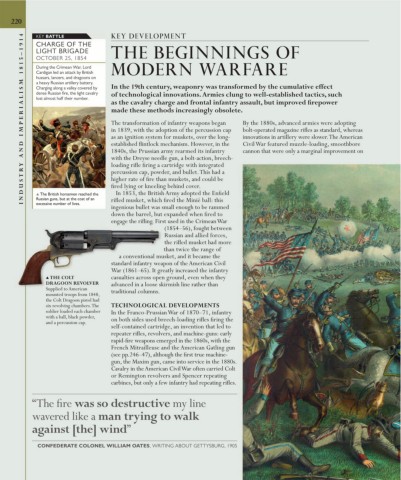
                 ▲ THE COLT              casualties across open ground, even when they
                 DRAGOON REVOLVER        advanced in a loose skirmish line rather than
                 Supplied to American    traditional columns.
                 mounted troops from 1848,
                 the Colt Dragoon pistol had
                 six revolving chambers. The   TECHNOLOGICAL DEVELOPMENTS
                 soldier loaded each chamber   In the Franco-Prussian War of 1870–71, infantry
                 with a ball, black powder,    on both sides used breech-loading rifles firing the
                 and a percussion cap.
                                         self-contained cartridge, an invention that led to
                                         repeater rifles, revolvers, and machine-guns: early
                                         rapid-fire weapons emerged in the 1860s, with the
                                         French Mitrailleuse and the American Gatling gun
                                         (see pp.246 –47), although the first true machine-
                                         gun, the Maxim gun, came into service in the 1880s.
                                         Cavalry in the American Civil War often carried Colt
                                         or Remington revolvers and Spencer repeating
                                         carbines, but only a few infantry had repeating rifles.


            “The fire was so destructive my line

            wavered like a man trying to walk

            against [the] wind”


              CONFEDERATE COLONEL WILLIAM OATES, WRITING ABOUT GETTYSBURG, 1905

