


Page 223 - (DK) Smithsinian - Military History: The Definitive Visual Guide to the Objects of Warfare
P. 223
221


            cannon of the Napoleonic era. However, from the
            1870s, breech-loading, rifled artillery, pioneered by
            the Prussians, transformed both range and rate of
            fire. Firing high-explosive steel shells, the French
            75 field gun, introduced in 1898, could fire up to
            30 rounds a minute up to 5 miles (8.5km).

            LOGISTICS AND COMMUNICATION
            Military commanders were mostly quick to
            adopt new technology. Two of the most important                                                                             THE BEGINNINGS OF MODERN  W
            influences on 19th-century warfare—railroads and
            the electric telegraph—were civilian inventions.
            Large-scale military use of railroads came in 1859,
            when the French moved over 100,000 soldiers
            by train to fight the Austrians in northern Italy;
            soon after, both the railroad and the telegraph were
            to prove invaluable in the American Civil War.

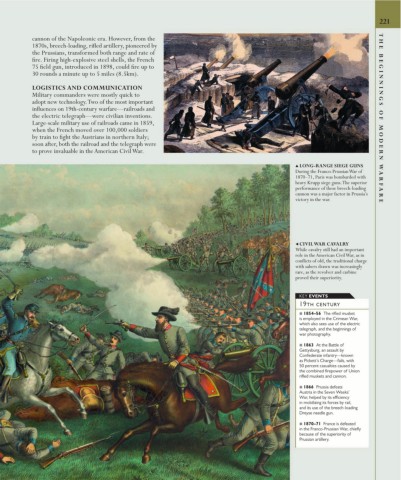
                                                                                                          ▲ LONG-RANGE SIEGE GUNS
                                                                                                          During the Franco-Prussian War of
                                                                                                          1870–71, Paris was bombarded with   ARF
                                                                                                          heavy Krupp siege guns. The superior
                                                                                                          performance of these breech-loading
                                                                                                          cannon was a major factor in Prussia’s   ARE
                                                                                                          victory in the war.


                                                                                                          ◀ CIVIL WAR CAVALRY
                                                                                                          While cavalry still had an important
                                                                                                          role in the American Civil War, as in
                                                                                                          conflicts of old, the traditional charge
                                                                                                          with sabers drawn was increasingly
                                                                                                          rare, as the revolver and carbine
                                                                                                          proved their superiority.


                                                                                                            KEY EVENTS
                                                                                                            19th century
                                                                                                            ◼ 1854–56  The rifled musket
                                                                                                            is employed in the Crimean War,
                                                                                                            which also sees use of the electric
                                                                                                            telegraph, and the beginnings of
                                                                                                            war photography.
                                                                                                            ◼ 1863  At the Battle of
                                                                                                            Gettysburg, an assault by
                                                                                                            Confederate infantry—known
                                                                                                            as Pickett’s Charge—fails, with
                                                                                                            50 percent casualties caused by
                                                                                                            the combined firepower of Union
                                                                                                            rifled muskets and cannon.

                                                                                                            ◼ 1866  Prussia defeats
                                                                                                            Austria in the Seven Weeks’
                                                                                                            War, helped by its efficiency
                                                                                                            in mobilizing its forces by rail,
                                                                                                            and its use of the breech-loading
                                                                                                            Dreyse needle gun.

                                                                                                            ◼ 1870–71  France is defeated
                                                                                                            in the Franco-Prussian War, chiefly
                                                                                                            because of the superiority of
                                                                                                            Prussian artillery.

