


Page 414 - (DK) Smithsinian - Military History: The Definitive Visual Guide to the Objects of Warfare
P. 414
412    STEALTH GROUND-ATTACK AIRCRAFT                                                              Faceted fuselage     Cockpit

         GE 1945–PRESENT  LOCKHEED                                                               Ruddervator  Elevons  Engine air intake  SIDE VIEW


            F-117 NIGHTHAWK


            The first operational aircraft designed around stealth technology,
                                                                                                                     Rear-facing
            signature, enabling it to strike undetected at heavily defended targets.
                                                                                                                                 Data
                                                                                                 tail
         A  the F-117 used faceting—sharply angled surfaces—to reduce its radar               V-shaped                floodlight  probes
         THE NUCLEAR   Lockheed began developing in 1975.  The   reduced the signature.  To avoid detection   Exhaust outlet  Brake-chute doors  In-flight   FLIR sensor
            The F-117 was a direct descendant of Have  their source, and a coating of matt-black
            Blue, an experimental stealth aircraft that
                                                     radar-absorbent material (RAM) further
            USAF received its first F-117s in 1982, but  the aircraft could not use radar itself,
            the plane’s existence remained a secret until  so navigation was by GPS and an inertial
                                                                                                                        refueling port
                                                     guidance system. Efforts to conceal the
            1988. Despite its F (fighter) designation,
            the Nighthawk was a ground-attack aircraft.  Nighthawk from heat-seeking missiles
                                                                                                                           PLAN VIEW
            It typically carried a pair of 2,000lb (910kg)  included dispensing with afterburners
            laser-guided bombs in its internal weapons
                                                     on the engines and cooling the exhaust
                                                                                              Nearly 66ft (20.1m) long and with a wingspan of
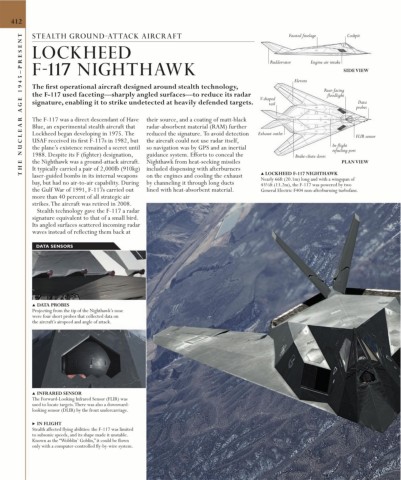
            bay, but had no air-to-air capability. During  by channeling it through long ducts    ▲ LOCKHEED F-117 NIGHTHAWK
                                                                                              43⅓ft (13.2m), the F-117 was powered by two
            the Gulf  War of 1991, F-117s carried out   lined with heat-absorbent material.   General Electric F404 non-afterburning turbofans.
            more than 40 percent of all strategic air
            strikes. The aircraft was retired in 2008.
              Stealth technology gave the F-117 a radar
            signature equivalent to that of a small bird.
            Its angled surfaces scattered incoming radar
            waves instead of reflecting them back at


              DATA SENSORS


            ▲ DATA PROBES
            Projecting from the tip of the Nighthawk’s nose
            were four short probes that collected data on
            the aircraft’s airspeed and angle of attack.


            ▲ INFRARED SENSOR
            The Forward-Looking Infrared Sensor (FLIR) was
            used to locate targets. There was also a downward-
            looking sensor (DLIR) by the front undercarriage.

            ▶ IN FLIGHT
            Stealth affected flying abilities: the F-117 was limited
            to subsonic speeds, and its shape made it unstable.
            Known as the “Wobblin’ Goblin,” it could be flown
            only with a computer-controlled fly-by-wire system.

