


Page 426 - (DK) Smithsinian - Military History: The Definitive Visual Guide to the Objects of Warfare
P. 426
424    AMERICAN AIRCRAFT CARRIER                                                                 Radar   Bridge       flight deck

                                                                                                                             Forward
         GE 1945–PRESENT  USS GEORGE                                                          Superstructure  Elevator      SIDE VIEW Anchor
                                                                                                       mast
                                                                                                                Flight deck

            WASHINGTON


                                                                                                Rudder
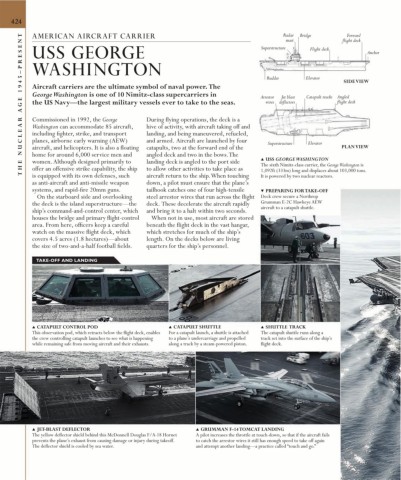
            Aircraft carriers are the ultimate symbol of naval power.  The


            the US Navy—the largest military vessels ever to take to the seas.
                                                                                                                         flight deck
                                                                                                wires deflectors
         A  George Washington is one of 10 Nimitz-class supercarriers in                      Arrestor   Jet blast   Catapult tracks   Angled
         THE NUCLEAR   including fighter, strike, and transport   landing, and being maneuvered, refueled,   ▲ USS GEORGE WASHINGTON  PLAN VIEW
                                                     During flying operations, the deck is a
            Commissioned in 1992, the George
                                                     hive of activity, with aircraft taking off and
            Washington can accommodate 85 aircraft,
                                                     and armed.  Aircraft are launched by four
            planes, airborne early warning (AEW)
                                                                                                               Elevator
                                                                                                Superstructure
            aircraft, and helicopters. It is also a floating  catapults, two at the forward end of the
            home for around 6,000 service men and
                                                     angled deck and two in the bows. The
            women. Although designed primarily to
                                                     landing deck is angled to the port side
            offer an offensive strike capability, the ship
                                                                                              1,092ft (333m) long and displaces about 103,000 tons.
            is equipped with its own defenses, such
                                                     aircraft return to the ship. When touching
                                                                                              It is powered by two nuclear reactors.
                                                     down, a pilot must ensure that the plane’s
            as anti-aircraft and anti-missile weapon   to allow other activities to take place as   The sixth Nimitz-class carrier, the George  Washington is
            systems, and rapid-fire 20mm guns.       tailhook catches one of four high-tensile   ▼ PREPARING FOR TAKE-OFF
              On the starboard side and overlooking   steel arrestor wires that run across the flight   Deck crew secure a Northrop
            the deck is the island superstructure—the   deck.  These decelerate the aircraft rapidly   Grumman E-2C Hawkeye AEW
            ship’s command-and-control center, which   and bring it to a halt within two seconds.    aircraft to a catapult shuttle.
            houses the bridge and primary flight-control   When not in use, most aircraft are stored
            area. From here, officers keep a careful   beneath the flight deck in the vast hangar,
            watch on the massive flight deck, which   which stretches for much of the ship’s
            covers 4.5 acres (1.8 hectares)—about    length. On the decks below are living
            the size of two-and-a-half football fields.   quarters for the ship’s personnel.

              TAKE-OFF AND LANDING


            ▲ CATAPULT CONTROL POD                           ▲ CATAPULT SHUTTLE               ▲ SHUTTLE  TRACK
            This observation pod, which retracts below the flight deck, enables    For a catapult launch, a shuttle is attached    The catapult shuttle runs along a
            the crew controlling catapult launches to see what is happening    to a plane’s undercarriage and propelled    track set into the surface of the ship’s
            while remaining safe from moving aircraft and their exhausts.  along a track by a steam-powered piston.  flight deck.


            ▲ JET-BLAST DEFLECTOR                                      ▲ GRUMMAN F-14 TOMCAT LANDING
            The yellow deflector shield behind this McDonnell Douglas F/A-18 Hornet   A pilot increases the throttle at touch-down, so that if the aircraft fails
            prevents the plane’s exhaust from causing damage or injury during takeoff.    to catch the arrestor wires it still has enough speed to take off again
            The deflector shield is cooled by sea water.               and attempt another landing—a practice called “touch and go.”

