


Page 429 - (DK) Smithsinian - Military History: The Definitive Visual Guide to the Objects of Warfare
P. 429
427


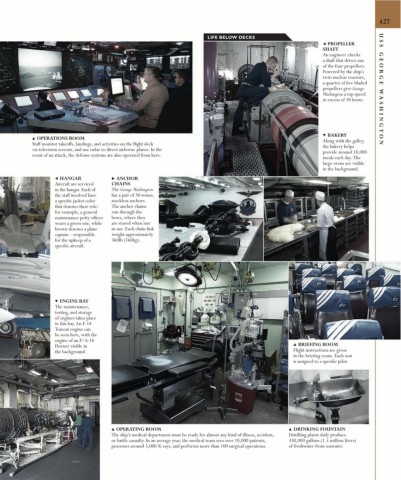
                                                                           LIFE BELOW DECKS
                                                                                                                    ◀ PROPELLER
                                                                                                                    SHAFT
                                                                                                                    An engineer checks
                                                                                                                    a shaft that drives one
                                                                                                                    of the four propellers.   USS GEORGE  W
                                                                                                                    Powered by the ship’s
                                                                                                                    twin nuclear reactors,
                                                                                                                    a quartet of five-bladed
                                                                                                                    propellers give George
                                                                                                                    Washington a top speed
                                                                                                                    in excess of 30 knots.  ASHINGT


                                                                                                                    ▼ BAKERY
            ▲ OPERATIONS ROOM                                                                                       Along with the galley,   ON
            Staff monitor takeoffs, landings, and activities on the flight deck                                     the bakery helps
            via television screens, and use radar to direct airborne planes. In the                                 provide around 18,000
            event of an attack, the defense systems are also operated from here.
                                                                                                                    meals each day.  The
                                                                                                                    large ovens are visible
                                                                                                                    in the background.
                    ◀ HANGAR             ▶ ANCHOR
                    Aircraft are serviced    CHAINS
                    in the hangar. Each of   The George  Washington
                    the staff involved have    has a pair of 30-tonne,
                    a specific jacket color    stockless anchors.
                    that denotes their role:    The anchor chains
                    for example, a general   run through the
                    maintenance petty officer   bows, where they
                    wears a green one, while    are stored when not
                    brown denotes a plane   in use. Each chain link
                    captain—responsible    weighs approximately
                    for the upkeep of a   360lb (160kg).
                    specific aircraft.


                    ▼ ENGINE BAY
                    The maintenance,
                    testing, and storage
                    of engines takes place
                    in this bay. An F-14
                    Tomcat engine can
                    be seen here, with the
                    engine of an F/A-18
                    Hornet visible in                                                                     ▲ BRIEFING ROOM
                    the background.                                                                       Flight instructions are given
                                                                                                          in the briefing room. Each seat
                                                                                                          is assigned to a specific pilot.


                                         ▲ OPERATING ROOM                                               ▲ DRINKING FOUNTAIN
                                         The ship’s medical department must be ready for almost any kind of illness, accident,    Distilling plants daily produce
                                         or battle casualty. In an average year, the medical team sees over 10,000 patients,   330,000 gallons (1.5 million liters)
                                         processes around 3,000 X-rays, and performs more than 100 surgical operations.  of freshwater from seawater.

