


Page 180 - (DK Eyewitness) Travel Guide - India
P. 180
178 CENTR AL INDIA
Decorative Elements of the Taj
It is widely believed that the Taj Mahal was designed
to represent an earthly replica of one of the houses of
paradise. Its impeccable marble facing, embellished by a
remarkable use of exquisite surface design, is a showcase
for the refined aesthetic that reached its height during
Shah Jahan’s reign. Described as “one of the most elegant
and har monious buildings in the world”, the Taj indeed
manifests the wealth and luxury of Mughal art as seen
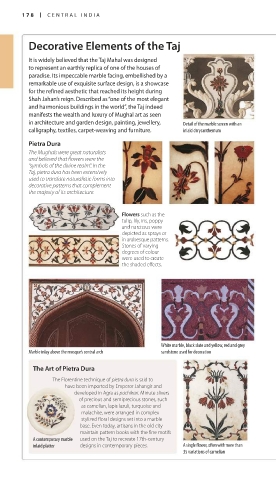
in architecture and garden design, painting, jewellery, Detail of the marble screen with an
calligraphy, textiles, carpet-weaving and furniture. inlaid chrysanthemum
Pietra Dura
The Mughals were great naturalists
and believed that flowers were the
“symbols of the divine realm”. In the
Taj, pietra dura has been extensively
used to translate naturalistic forms into
decorative patterns that complement
the majesty of its architecture.
Flowers such as the
tulip, lily, iris, poppy
and narcissus were
depicted as sprays or
in arabesque patterns.
Stones of varying
degrees of colour
were used to create
the shaded effects.
White marble, black slate and yellow, red and grey
Marble inlay above the mosque’s central arch sandstone used for decoration
The Art of Pietra Dura
The Florentine technique of pietra dura is said to
have been imported by Emperor Jahangir and
developed in Agra as pachikari. Minute slivers
of precious and semiprecious stones, such
as carnelian, lapis lazuli, turquoise and
malachite, were arranged in complex
stylized floral designs set into a marble
base. Even today, artisans in the old city
maintain pattern books with the fine motifs
A contemporary marble used on the Taj to recreate 17th-century
inlaid platter designs in contemporary pieces. A single flower, often with more than
35 variations of carnelian
178-179_EW_India.indd 178 26/04/17 11:44 am
Eyewitness Travel LAYERS PRINTED:
Feature template “UK” LAYER
(SourceReport v1.3)
Date 18th October 2012
Size 125mm x 217mm

