


Page 177 - (DK Eyewitness) Travel Guide - India
P. 177
AG R A 175
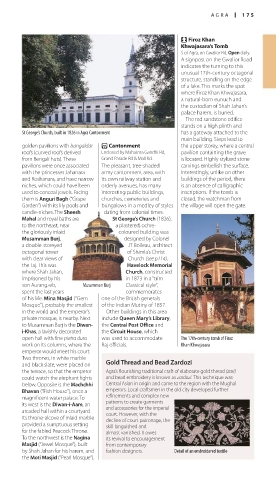
Firoz Khan
Khwajasara’s Tomb
S of Agra, on Gwalior Rd. Open daily.
A signpost on the Gwalior Road
indicates the turning to this
unusual 17th-century octagonal
structure, standing on the edge
of a lake. This marks the spot
where Firoz Khan Khwajasara,
a natural-born eunuch and
the custodian of Shah Jahan’s
palace harem, is buried.
The red sandstone edifice
stands on a high plinth and
St George’s Church, built in 1826 in Agra Cantonment has a gateway attached to the
main building. Steps lead to
golden pavilions with bangaldar P Cantonment the upper storey, where a central
roofs (curved roofs derived Enclosed by Mahatma Gandhi Rd, pavilion containing the grave
from Bengali huts). These Grand Parade Rd & Mall Rd. is located. Highly stylized stone
pavilions were once associated The pleasant, tree-shaded carvings embellish the surface.
with the princesses Jahanara army cantonment area, with Interestingly, unlike on other
and Roshanara, and have narrow its own railway station and buildings of the period, there
niches, which could have been orderly avenues, has many is an absence of calligraphic
used to conceal jewels. Facing interesting public buildings, inscriptions. If the tomb is
them is Anguri Bagh (“Grape churches, cemeteries and closed, the watchman from
Garden”) with its lily pools and bungalows in a medley of styles the village will open the gate.
candle-niches. The Sheesh dating from colonial times.
Mahal and royal baths are St George’s Church (1826),
to the northeast, near a plastered, ochre-
the gloriously inlaid coloured building was
Musamman Burj, designed by Colonel
a double-storeyed JT Boileau, architect
octagonal tower of Shimla’s Christ
with clear views of Church (see p114).
the Taj. This was Havelock Memorial
where Shah Jahan, Church, constructed
imprisoned by his in 1873 in a “trim
son Aurangzeb, Musamman Burj Classical style”,
spent the last years commemorates
of his life. Mina Masjid (“Gem one of the British generals
Mosque”), probably the smallest of the Indian Mutiny of 1857.
in the world and the emperor’s Other buildings in this area
private mosque, is nearby. Next include Queen Mary’s Library,
to Musamman Burj is the Diwan- the Central Post Office and
i-Khas, a lavishly decorated the Circuit House, which
open hall with fine pietra dura was used to accommodate The 17th-century tomb of Firoz
work on its columns, where the Raj officials. Khan Khwajasara
emperor would meet his court.
Two thrones, in white marble
and black slate, were placed on Gold Thread and Bead Zardozi
the terrace, so that the emperor Agra’s flourishing traditional craft of elaborate gold thread (zari)
could watch the elephant fights and bead embroidery is known as zardozi. This technique was
below. Opposite is the Machchhi Central Asian in origin and came to the region with the Mughal
Bhavan (“Fish House”), once a emperors. Local craftsmen in the old city developed further
magnificent water palace. To refinements and complex new
its west is the Diwan-i-Aam, an patterns to create garments
and accessories for the imperial
arcaded hall within a courtyard. court. However, with the
Its throne-alcove of inlaid marble decline of court patronage, the
provided a sumptuous setting skill languished and
for the fabled Peacock Throne. almost vanished. It owes
To the northwest is the Nagina its revival to encouragement
Masjid (“Jewel Mosque”), built from contemporary
by Shah Jahan for his harem, and fashion designers. Detail of an embroidered textile
the Moti Masjid (“Pearl Mosque”).
174-175_EW_India.indd 175 26/04/17 11:43 am

