


Page 186 - (DK Eyewitness) Travel Guide - India
P. 186
184 CENTR AL INDIA
5 Fatehpur Sikri
Built by Emperor Akbar between 1571 and
1585 in honour of Salim Chishti, a famous Sufi
saint of the Chishti order (see p380), Fatehpur
Sikri was the Mughal capital for 14 years.
A fine example of a Mughal walled city with
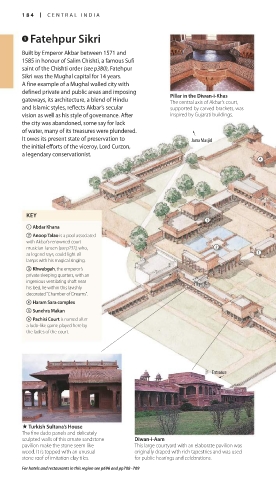
defined private and public areas and imposing Pillar in the Diwan-i-Khas
gateways, its architecture, a blend of Hindu The central axis of Akbar’s court,
and Islamic styles, reflects Akbar’s secular supported by carved brackets, was
vision as well as his style of governance. After inspired by Gujarati buildings.
the city was abandoned, some say for lack
of water, many of its treasures were plundered.
It owes its present state of preservation to Jama Masjid
the initial efforts of the viceroy, Lord Curzon,
a legendary conservationist.
KEY
1 Abdar Khana
2 Anoop Talao is a pool associated
with Akbar’s renowned court
musician Tansen (see p232), who,
as legend says, could light oil
lamps with his magical singing.
3 Khwabgah, the emperor’s
private sleeping quarters, with an
ingenious ventilating shaft near
his bed, lie within this lavishly
decorated “Chamber of Dreams”.
4 Haram Sara complex
5 Sunehra Makan
6 Pachisi Court is named after
a ludo-like game played here by
the ladies of the court.
Entrance
. Turkish Sultana’s House
The fine dado panels and delicately
sculpted walls of this ornate sandstone Diwan-i-Aam
pavilion make the stone seem like This large courtyard with an elaborate pavilion was
wood. It is topped with an unusual originally draped with rich tapestries and was used
stone roof of imitation clay tiles. for public hearings and celebrations.
For hotels and restaurants in this region see p696 and pp708–709
184-185_EW_India.indd 184 26/04/17 11:44 am
Eyewitness Travel LAYERS PRINTED:
Starsight template “UK” LAYER
(Source v2.7)
Date 24th April 2013
Size 125mm x 217mm

