


Page 188 - (DK Eyewitness) Travel Guide - India
P. 188
186 CENTR AL INDIA
Exploring Fatehpur Sikri
The principal buildings of the imperial palace complex,
clustered on a series of terraces along the sandstone
ridge, formed the core of Akbar’s city. Stylistically,
they marked the absorption of Gujarat into the Mughal
Empire and reveal a successful synthesis of pre-Islamic
and Hindu as well as Jain architecture (as in the carved
brackets) with the elegant domes and arches of Islamic
buildings. The concentric terraces clearly separate
the public spaces from the private royal quarters. The
buildings are mostly in Akbar’s favourite red sandstone,
which was quarried from the ridge on which they stand.
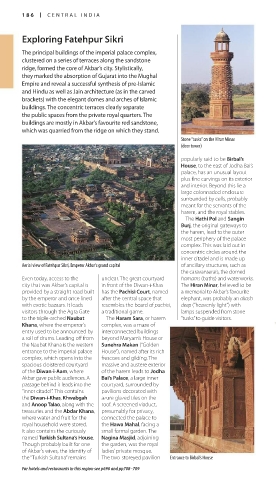
Stone “tusks” on the Hiran Minar
(deer tower)
popularly said to be Birbal’s
House, to the east of Jodha Bai’s
palace, has an unusual layout
plus fine carvings on its exterior
and interior. Beyond this lie a
large colonnaded enclosure
surrounded by cells, probably
meant for the servants of the
harem, and the royal stables.
The Hathi Pol and Sangin
Burj, the original gateways to
the harem, lead to the outer-
most periphery of the palace
complex. This was laid out in
concentric circles around the
inner citadel and is made up
Aerial view of Fatehpur Sikri, Emperor Akbar’s grand capital of ancillary structures, such as
the caravanserais, the domed
Even today, access to the unclear. The great courtyard hamams (baths) and waterworks.
city that was Akbar’s capital is in front of the Diwan-i-Khas The Hiran Minar, believed to be
provided by a straight road built has the Pachisi Court, named a memorial to Akbar’s favourite
by the emperor and once lined after the central space that elephant, was probably an akash
with exotic bazaars. It leads resembles the board of pachisi, deep (“heavenly light”) with
visitors through the Agra Gate a traditional game. lamps suspended from stone
to the triple-arched Naubat The Haram Sara, or harem “tusks” to guide visitors.
Khana, where the emperor’s complex, was a maze of
entry used to be announced by interconnected buildings
a roll of drums. Leading off from beyond Maryam’s House or
the Naubat Khana is the western Sunehra Makan (“Golden
entrance to the imperial palace House”), named after its rich
complex, which opens into the frescoes and gilding. The
spacious cloistered courtyard massive and austere exterior
of the Diwan-i-Aam, where of the harem leads to Jodha
Akbar gave public audiences. A Bai’s Palace, a large inner
passage behind it leads into the courtyard, surrounded by
“inner citadel”. This contains pavilions decorated with
the Diwan-i-Khas, Khwabgah azure glazed tiles on the
and Anoop Talao, along with the roof. A screened viaduct,
treasuries and the Abdar Khana, presumably for privacy,
where water and fruit for the connected the palace to
royal household were stored. the Hawa Mahal, facing a
It also contains the curiously small formal garden. The
named Turkish Sultana’s House. Nagina Masjid, adjoining
Though probably built for one the garden, was the royal
of Akbar’s wives, the identity of ladies’ private mosque.
the “Turkish Sultana” remains The two-storeyed pavilion Entrance to Birbal’s House
For hotels and restaurants in this region see p696 and pp708–709
186-187_EW_India.indd 186 04/05/17 3:23 pm
Eyewitness Travel LAYERS PRINTED:
Catalogue template “UK” LAYER
(Source v2.6)
Date 12th July 2013
Size 125mm x 217mm

