


Page 246 - (DK Eyewitness) Travel Guide - India
P. 246
244 CENTR AL INDIA
9 Bhopal
The capital of Madhya Pradesh, Bhopal was founded in the
11th century by Raja Bhoj of the Paramara dynasty. By the
18th century, it was held by a Muslim dynasty, whose rulers
included several remarkable women, the Begums of Bhopal.
The city, ringed by hills, stretches along the shores of two
artificial lakes, the Upper and Lower lakes. The old quarter,
north of the lakes, is a maze of narrow lanes, bazaars and
mosques. To the south is the new city, with its leafy suburbs
and industrial enclaves. In December 1984, a toxic gas leak
from the Union Carbide factory claimed the lives of 15,000
people, in one of the world’s worst industrial disasters. With Fountain and tank inside the 19th-century
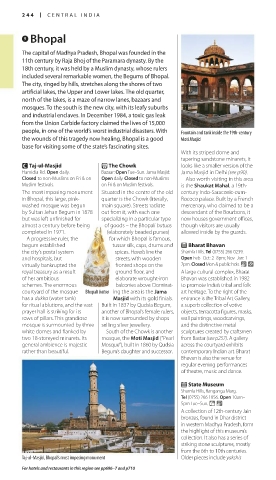
the wounds of this tragedy now healing, Bhopal is a good Moti Masjid
base for visiting some of the state’s fascinating sites.
With its striped dome and
tapering sandstone minarets, it
U Taj-ul-Masjid P The Chowk looks like a smaller version of the
Hamidia Rd. Open daily. Bazaar: Open Tue–Sun. Jama Masjid: Jama Masjid in Delhi (see p90).
Closed to non-Muslims on Fri & on Open daily. Closed to non-Muslims Also worth visiting in this area
Muslim festivals. on Fri & on Muslim festivals. is the Shaukat Mahal, a 19th-
The most imposing monument Situated in the centre of the old century Indo-Saracenic-cum-
in Bhopal, this large, pink- quarter is the Chowk (literally, Rococo palace. Built by a French
washed mosque was begun main square). Streets radiate mercenary, who claimed to be a
by Sultan Jehan Begum in 1878 out from it, with each one descendant of the Bourbons, it
but was left unfinished for specializing in a particular type now houses government offices,
almost a century before being of goods – the Bhopali batuas though visitors are usually
completed in 1971. (elaborately beaded purses) allowed inside by the guards.
A progressive ruler, the for which Bhopal is famous,
begum established tussar silk, caps, drums and E Bharat Bhavan
the city’s postal system spices. Havelis line the Shamla Hills. Tel (0755) 266 0239.
and hospitals, but streets, with wooden- Open Feb–Oct: 2–8pm; Nov–Jan: 1–
virtually bankrupted the fronted shops on the 7pm. Closed Mon & public hols. & 0
royal treasury as a result ground floor, and A large cultural complex, Bharat
of her ambitious elaborate wrought-iron Bhavan was established in 1982
schemes. The enormous balconies above. Dominat- to promote India’s tribal and folk
courtyard of the mosque Bhopali batua ing the area is the Jama art heritage. To the right of the
has a dukka (water tank) Masjid with its gold finials. entrance is the Tribal Art Gallery,
for ritual ablutions, and the vast Built in 1837 by Qudsia Begum, a superb collec tion of votive
prayer hall is striking for its another of Bhopal’s female rulers, objects, terracotta figures, masks,
rows of pillars. This grandiose it is now surrounded by shops wall paintings, wood carvings,
mosque is surmounted by three selling silver jewellery. and the distinctive metal
white domes and flanked by South of the Chowk is another sculptures created by craftsmen
two 18-storeyed minarets. Its mosque, the Moti Masjid (“Pearl from Bastar (see p257). A gallery
general ambience is majestic Mosque”), built in 1860 by Qudsia across the courtyard exhibits
rather than beautiful. Begum’s daughter and successor. contemporary Indian art. Bharat
Bhavan is also the venue for
regular evening perfor mances
of theatre, music and dance.
E State Museum
Shamla Hills, Banganga Marg.
Tel (0755) 266 1856. Open 10am–
5pm Tue–Sun. = &
A collection of 12th-century Jain
bronzes, found in Dhar district
in western Madhya Pradesh, form
the highlight of this museum’s
collection. It also has a series of
striking stone sculptures, mostly
from the 6th to 10th centuries.
Taj-ul-Masjid, Bhopal’s most imposing monument Older pieces include yakshis
For hotels and restaurants in this region see pp696–7 and p710
244-245_EW_India.indd 244 26/04/17 11:44 am
Eyewitness Travel LAYERS PRINTED:
Catalogue template “UK” LAYER
(Source v2.4)
Date 25th April 2013
Size 125mm x 217mm

