


Page 345 - (DK Eyewitness) Travel Guide - India
P. 345
ASSA M & THE NOR THEAST 343
surmounting its gable. A less-
modernized Angami Naga village
is Khonoma, 20 km (12 miles)
southwest of Kohima, with its
wooden houses, carved gateway
and surrounding stone wall. The
villagers are known for their
agricultural skills – terraced
paddy fields cover the hillside,
growing 20 varieties of rice,
and a system of bamboo pipes
irrigates the fields.
E State Museum
Tel (0370) 226 0133. Open Mon–Sat.
Closed public hols. &
Kohima’s Baptist Church, one of many churches in the area
i Dimapur
Boat rides are also offered. handsome Naga people (see Kohima district. 74 km (46 miles)
However, due to current pp340–41) in their colourful NW of Kohima. * 375,800. £ @
political instability, only day- woven shawls; they come from n Tourist Office, near Nagaland State
trips to Loktak Lake are possible. surrounding villages to sell their Transport Office. Travel permits:
produce. The market also offers required (see pp734–5).
visitors a glimpse of the diet
u Kohima that supposedly made the This bustling town in the plains
Nagas such formid able warriors functions as a gateway to the
Kohima district. 339 km (211 miles) E
of Guwahati. * 268,000. £ Dimapur, – bees’ larvae and dog meat rest of Nagaland. It was founded
74 km (46 miles) NW of Kohima, then are favourites. by the Kachari rulers, a Tibeto-
taxi or bus. @ n Nagaland Tourism, The State Museum, 2 km Burmese people who were
(0370) 224 3124. Travel permits: (1 mile) north of the bazaar, has displaced from their territories
required (see p734–5). an excellent anthropolog ical in Assam in the 13th century by
collection of Naga masks, textiles, the invading Ahoms (see p336).
The capital of Nagaland, Kohima, jewellery and totem pillars from Some of the ruins of their old
at an altitude of all the 16 Naga tribes. capital can be seen in the heart
1,500 m (4,921 ft), is a Particularly intriguing of the town. Most notable are
small, pleasant town is a large ceremonial 30 carved megaliths, believed to
surrounded by hills drum that looks like a be fertility symbols. About 5 km
which are dotted with dugout canoe, and is (3 miles) from the city centre,
villages. Kohima is kept in a shed outside on the road to Kohima, is the
famous in World War II the museum. The drum Ruzaphema Bazaar, which
history for the decisive is engraved with displays a fascinating range of
battle fought on stylized waves, and has tribal handicrafts.
the tennis court gongs that look like
of the British deputy War Cemetery, Kohima paddles. This and other
commissioner’s house, factors, such as the use
that finally stopped the of sea shells in their costumes,
Japanese advance into has led some anthropol ogists to
India in April 1944. conjecture that the Nagas were
Those who fell in the battle originally a seafaring people,
are buried in the beautifully possibly from Sumatra. Today,
kept War Cemetery covering a high percentage of Nagas are
a terraced hillside. A poignant Christians, and a church can be
inscription at the base of one found in almost every corner
of the two large crosses here of the state.
reads: “When you go home/ Tell The original village of Kohima,
them of us and say/ For your Bara Basti, is a settlement of
tomorrow/ We gave our today.” the Angami Naga tribe, and is
The Cathedral of Reconciliation, located on a hill overlooking the
which overlooks the cemetery, town. Though now considerably
was built in 1995, partly funded modernized, it still has its cere-
by the Japanese government. monial gateway and a large
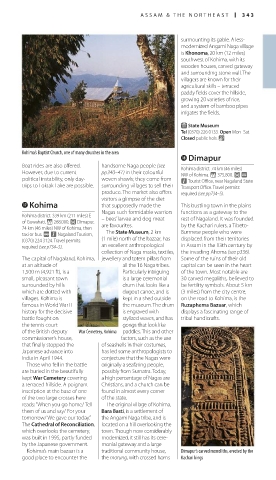
Kohima’s main bazaar is a traditional community house, Dimapur’s carved monoliths, erected by the
good place to encounter the the morung, with crossed horns Kachari kings
342-343_EW_India.indd 343 26/04/17 11:46 am

