


Page 364 - (DK Eyewitness) Travel Guide - India
P. 364
362 WESTERN INDIA
Jaipur: Jantar Mantar
Of the five observatories built by Sawai Jai Singh II, the
one in Jaipur is the largest and best preserved; the others
are in Delhi (see p82), Ujjain, Mathura and Varanasi. A keen
astronomer himself, Jai Singh kept abreast of the latest
astronomical studies in the world, and was most inspired
by the work of Mirza Ulugh Beg, the astronomer-king of
Samarkand. Built between 1728 and 1734, the observatory
has been described as “the most realistic and logical
landscape in stone”, its 19 instruments resembling a giant
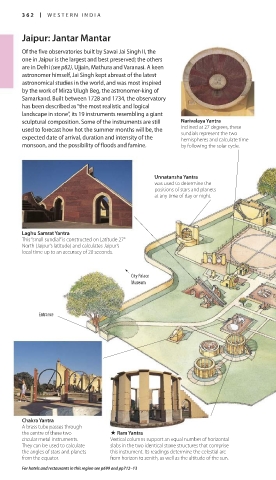
sculptural composition. Some of the instruments are still Narivalaya Yantra
used to forecast how hot the summer months will be, the Inclined at 27 degrees, these
sundials represent the two
expected date of arrival, duration and intensity of the hemispheres and calculate time
monsoon, and the possibility of floods and famine. by following the solar cycle.
Unnatansha Yantra
was used to determine the
positions of stars and planets
at any time of day or night.
Laghu Samrat Yantra
This “small sundial” is constructed on Latitude 27°
North (Jaipur’s latitude) and calculates Jaipur’s
local time up to an accuracy of 20 seconds.
City Palace
Museum
Entrance
Chakra Yantra
A brass tube passes through
the centre of these two . Ram Yantra
circular metal instruments. Vertical columns support an equal number of horizontal
They can be used to calculate slabs in the two identical stone structures that comprise
the angles of stars and planets this instrument. Its readings determine the celestial arc
from the equator. from horizon to zenith, as well as the altitude of the sun.
For hotels and restaurants in this region see p699 and pp712–13
362-363_EW_India.indd 362 26/04/17 11:46 am
Eyewitness Travel LAYERS PRINTED:
Starsight template “UK” LAYER
(Source v2.7)
Date 24th April 2013
Size 125mm x 217mm

