


Page 367 - (DK Eyewitness) Travel Guide - India
P. 367
JAIPUR 365
Jaipur Jewellery
Be it the fabulous rubies and emeralds sported by former maharajas and their queens
or the splendid silver and bone ornaments worn by peasants, jewellery is an integral
part of Rajasthani culture. Even camels, horses and elephants have specially designed
anklets and necklaces. Jaipur is one of the largest ornament-making centres in India, and
meenakari (enamel work) and kundankari (inlay work with gems) are the two traditional
techniques for which it is most famous. In the 16th century, Man Singh I (see p368),
influenced by the prevailing fashions of the Mughal court, brought five Sikh enamel
workers from Lahore to his state. Since then, generations of highly skilled jewellers
have lived and worked here. Jaipur caters to every taste, from chunky silver ornaments
to more sophisticated designs intricately set in gold with precious stones.
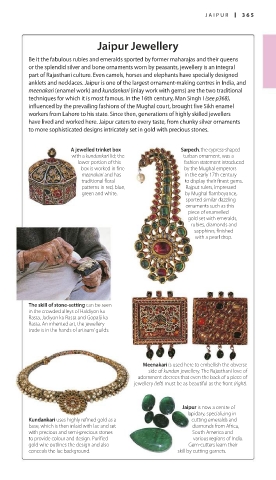
A jewelled trinket box Sarpech, the cypress-shaped
with a kundankari lid; the turban ornament, was a
lower portion of this fashion statement introduced
box is worked in fine by the Mughal emperors
meenakari and has in the early 17th century
traditional floral to display their finest gems.
patterns in red, blue, Rajput rulers, impressed
green and white. by Mughal flamboyance,
sported similar dazzling
ornaments such as this
piece of enamelled
gold set with emeralds,
rubies, diamonds and
sapphires, finished
with a pearl drop.
The skill of stone-setting can be seen
in the crowded alleys of Haldiyon ka
Rasta, Jadiyon ka Rasta and Gopalji ka
Rasta. An inherited art, the jewellery
trade is in the hands of artisans’ guilds.
Meenakari is used here to embellish the obverse
side of kundan jewellery. The Rajasthani love of
adornment decrees that even the back of a piece of
jewellery (left) must be as beautiful as the front (right).
Jaipur is now a centre of
lapidary, specializing in
Kundankari uses highly refined gold as a cutting emeralds and
base, which is then inlaid with lac and set diamonds from Africa,
with precious and semi-precious stones South America and
to provide colour and design. Purified various regions of India.
gold wire outlines the design and also Gem-cutters learn their
conceals the lac background. skill by cutting garnets.
364-365_EW_India.indd 365 26/04/17 11:46 am

