


Page 416 - (DK Eyewitness) Travel Guide - India
P. 416
414 WESTERN INDIA
1 Ahmedabad for Friday prayers. The masons
who constructed this yellow
Gujarat’s leading city, Ahmedabad was the state capital until sandstone structure ingeniously
1970. This bustling industrial and commercial centre also has used pieces retrieved from
a fascinating old quarter, redolent with Gujarat’s traditional demolished Hindu and Jain
culture and history. Legend has it that the city owes its temples – the black slab close
to the main arch is said to be
foundation to Sultan Ahmed Shah (r.1411–42), who, while the base of an inverted Jain
out hunting, encountered a warren of rabbits on the banks idol. The mosque’s 15 domes
of the Sabarmati river. Astonishingly, the rabbits turned are suppor ted by 260 pillars
fiercely on his hounds and defended their territory. Viewing covered with intricate carvings.
this as an auspicious sign, the sultan built his new capital The interior is illuminated by
natural light filtered through
at this site and named it after himself – Ahmedabad.
latticework screens.
Outside the east entrance
of the Jama Masjid, close to
the jewellery bazaar in Manek
Chowk, is the Tomb of Ahmed
Shah, with elegant pillared
verandahs, where the sultan, his
son and grandson are buried. In
the heart of the market, echoing
the plan and layout of the sultan’s
tomb, lies Rani-ka-Hazira, the
mausoleum of his many queens.
To the southeast of Manek
Chowk is Rani Sipri’s Mosque,
also known as Masjide Nagina
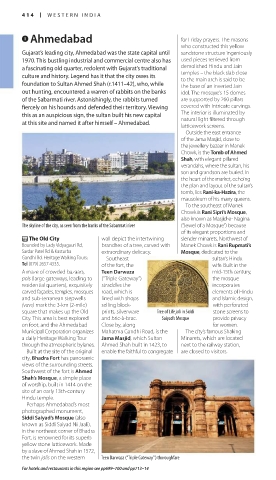
The skyline of the city, as seen from the banks of the Sabarmati river (“Jewel of a Mosque”) because
of its elegant proportions and
P The Old City wall depict the intertwining slender minarets. Northwest of
Bounded by Lady Vidyagauri Rd, branches of a tree, carved with Manek Chowk is Rani Rupmati’s
Sardar Patel Rd & Kasturba extraordin ary delicacy. Mosque, dedica ted to the
Gandhi Rd. Heritage Walking Tours: Southeast sultan’s Hindu
Tel (079) 2657 4335. of the fort, the wife. Built in the
A maze of crowded bazaars, Teen Darwaza mid15th cen tury,
pols (large gateways, leading to (“Triple Gateway”) the mosque
residential quarters), exquisitely straddles the incorporates
carved façades, temples, mosques road, which is elements of Hindu
and subterranean stepwells lined with shops and Islamic design,
(vavs) mark the 3km (2mile) selling block with perforated
square that makes up the Old prints, silverware Tree of Life jali in Siddi stone screens to
City. This area is best explored and bricàbrac. Saiyad’s Mosque provide privacy
on foot, and the Ahmedabad Close by, along for women.
Municipal Corporation organizes Mahatma Gandhi Road, is the The city’s famous Shaking
a daily Heritage Walking Tour Jama Masjid, which Sultan Minarets, which are located
through the atmospheric bylanes. Ahmed Shah built in 1423, to next to the railway station,
Built at the site of the original enable the faithful to congregate are closed to visitors.
city, Bhadra Fort has panoramic
views of the surrounding streets.
Southwest of the fort is Ahmed
Shah’s Mosque, a simple place
of worship, built in 1414 on the
site of an early 13thcentury
Hindu temple.
Perhaps Ahmedabad’s most
photographed monument,
Siddi Saiyad’s Mosque (also
known as Siddi Saiyad Ni Jaali),
in the northeast corner of Bhadra
Fort, is renowned for its superb
yellow stone lattice work. Made
by a slave of Ahmed Shah in 1572,
the twin jalis on the western Teen Darwaza (“Triple Gateway” ) thoroughfare
For hotels and restaurants in this region see pp699–700 and pp713–14
414-415_EW_India.indd 414 26/04/17 11:54 am

