


Page 412 - (DK Eyewitness) Travel Guide - India
P. 412
410 WESTERN INDIA
l Ranthambhore National Park
This park lies in the shadow of the Aravalli and Vindhya
mountain ranges and covers a core area of 392 sq km
(151 sq miles). Its razor-sharp ridges, deep boulder-filled
gorges, lakes and jungles are the habitat of carnivores
such as the caracal, panther, jackal and hyena, numerous Delhi
species of deer, and a rich variety of resident and
migratory birds. The most famous resident, however, is
the endangered tiger, and it is a unique experience to
catch glimpses of this majestic animal. Like other parks
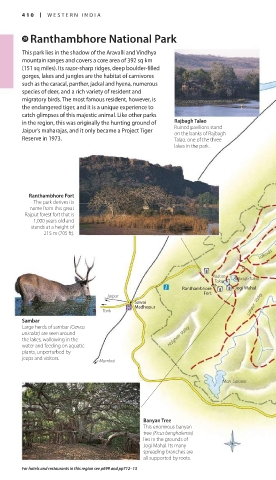
in the region, this was originally the hunting ground of Rajbagh Talao
Ruined pavilions stand
Jaipur’s maharajas, and it only became a Project Tiger on the banks of Rajbagh
Reserve in 1973. Talao, one of the three
lakes in the park. Banas
Ranthambhore Fort
The park derives its
name from this great
Rajput forest fort that is
1,000 years old and
stands at a height of J
215 m (705 ft). Semli
Lakarda Valley Lakarda Valley
J
Gilai Sagar
Padam Rajbagh Talao
Talao Khandar
J
Ranthambhore Jogi Mahal Fort
Jaipur Fort
Sawai Lahpur Valley
Madhopur Lahpur
Tonk
Sambar
Large herds of sambar (Cervus
unicolor) are seen around Nalghati Valley
the lakes, wallowing in the
water and feeding on aquatic
plants, unperturbed by
jeeps and visitors. Khatola
Mumbai
Man Sarovar
Banyan Tree
This enormous banyan
tree (Ficus benghalensis)
lies in the grounds of
Jogi Mahal. Its many
spreading branches are
all supported by roots.
For hotels and restaurants in this region see p699 and pp712–13
410-411_EW_India.indd 410 26/04/17 11:46 am
Eyewitness Travel LAYERS PRINTED:
Starsight template “UK” LAYER
(Source v2.7)
Date 24th April 2013
Size 125mm x 217mm

