


Page 423 - (DK Eyewitness) Travel Guide - India
P. 423
GUJAR A T 421
11 smaller shrines and three
40-m (131-ft) tall gateways.
Two porches and four columns
from the main shrine are all
that remain today, together
with a well-preserved, carved
gateway with two high
columns. An exploration of
the town reveals interesting
wooden havelis and pillared
mansions, built by Muslim
traders in the 19th century.
Environs
This region has the popular
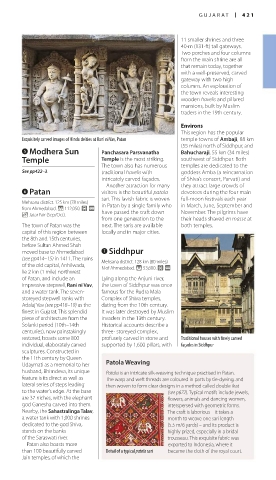
Exquisitely carved images of Hindu deities at Rani ni Vav, Patan temple towns of Ambaji, 88 km
(55 miles) north of Siddhpur, and
5 Modhera Sun Panchasara Parsvanatha Bahucharaji, 55 km (34 miles)
Temple Temple is the most striking. southwest of Siddhpur. Both
The town also has numerous temples are dedicated to the
See pp422–3. traditional havelis with goddess Amba (a reincarnation
intricately carved façades. of Shiva’s consort, Parvati) and
Another attraction for many they attract large crowds of
6 Patan visitors is the beautiful patola devotees during the four main
sari. This lavish fabric is woven full-moon festivals each year
Mehsana district. 125 km (78 miles)
from Ahmedabad. * 112,050. £ @ in Patan by a single family who in March, June, September and
_ Jatar Fair (Sep/Oct). have passed the craft down November. The pilgrims have
from one generation to the their heads shaved en masse at
The town of Patan was the next. The saris are available both temples.
capital of this region between locally and in major cities.
the 8th and 15th centuries,
before Sultan Ahmed Shah
moved base to Ahmedabad 7 Siddhpur
(see pp414–15) in 1411. The ruins Mehsana district. 128 km (80 miles)
of the old capital, Anhilwada, N of Ahmedabad. * 53,600. £ @
lie 2 km (1 mile) northwest
of Patan, and include an Lying along the Anjuni river,
impressive stepwell, Rani ni Vav, the town of Siddhpur was once
and a water tank. The seven- famous for the Rudra Mala
storeyed stepwell ranks with Complex of Shiva temples,
Adalaj Vav (see pp418–19) as the dating from the 10th century.
finest in Gujarat. This splendid It was later destroyed by Muslim
piece of architecture from the invaders in the 13th century.
Solanki period (10th–14th Historical accounts describe a
centuries), now painstakingly three- storeyed complex,
restored, boasts some 800 profusely carved in stone and Traditional houses with finely carved
individual, elaborately carved supported by 1,600 pillars, with façades in Siddhpur
sculptures. Constructed in
the 11th century by Queen
Udaymati as a memorial to her Patola Weaving
husband, Bhimdeva, its unique Patola is an intricate silk-weaving technique practised in Patan.
feature is its direct as well as The warp and weft threads are coloured in parts by tie-dyeing, and
lateral series of steps leading then woven to form clear designs in a method called double ikat
to the water’s edge. At the base (see p672). Typical motifs include jewels,
are 37 niches, with the elephant flowers, animals and dancing women,
god Ganesha carved into them. interspersed with geometric forms.
Nearby, the Sahastralinga Talav, The craft is laborious – it takes a
a water tank with 1,000 shrines month to weave one sari length
dedicated to the god Shiva, (5.5 m/6 yards) – and its product is
stands on the banks highly prized, especially in a bridal
of the Saraswati river. trousseau. This exquisite fabric was
Patan also boasts more exported to Indonesia, where it
than 100 beautifully carved Detail of a typical patola sari became the cloth of the royal court.
Jain temples, of which the
420-421_EW_India.indd 421 26/04/17 11:47 am

