


Page 426 - (DK Eyewitness) Travel Guide - India
P. 426
424 WESTERN INDIA
0 Surat
Surat district. 234 km (145 miles) S of
Ahmedabad. * 5,374,400. £ @
n 1/847 Athugar St, Nanpura, (0261)
247 6586. ( Mon–Sat.
Strategically located on the coast,
Surat was once a prosperous
port, and many powers battled
to control it between the 16th
and 18th centuries. At various
times the Portuguese, Dutch,
Mughals, Marathas and British
held sway here, but its importance
began to wane after 1837,
when it was ravaged by flood
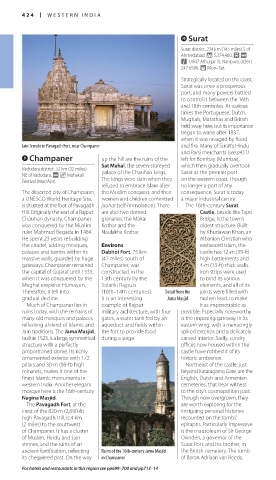
Jain Temple in Pavagadh Fort, near Champaner and fire. Many of Surat’s Hindu
and Parsi merchants (see p451)
9 Champaner up the hill are the ruins of the left for Bombay (Mumbai),
Sat Mahal, the seven-storeyed which then gradually overtook
Vadodara district. 52 km (32 miles)
NE of Vadodara. @ _ Mahakali palace of the Chauhan kings. Surat as the premier port
Festival (Mar/Apr). The kings were slain when they on the western coast. Though
refused to embrace Islam after no longer a port of any
The deserted city of Champaner, the Muslim conquest, and their consequence, Surat is today
a UNESCO World Heritage Site, women and children committed a major industrial centre.
is situated at the foot of Pavagadh jauhar (self-immolation). There The 16th-century Surat
Hill. Originally the seat of a Rajput are also two domed Castle, beside the Tapti
Chauhan dynasty, Champaner granaries, the Makai Bridge, is the town’s
was conquered by the Muslim Kothar and the oldest structure. Built
ruler Mahmud Begada in 1484. Naulakha Kothar. by Khudawan Khan, an
He spent 23 years rebuilding Albanian Christian who
the citadel, adding mosques, Environs embraced Islam, the
palaces and tombs within its Dabhoi Fort, 75 km castle has 12-m (39-ft)
massive walls, guarded by huge (47 miles) south of high battlements and
gateways. Champaner remained Champaner, was 4-m (13-ft) thick walls.
the capital of Gujarat until 1535, constructed in the Iron strips were used
when it was conquered by the 13th century by the to bind its various
Mughal emperor Humayun. Solanki Rajputs elements, and all of its
Thereafter, it fell into (10th–14th centuries). Detail from the joints were filled with
gradual decline. It is an interesting Jama Masjid molten lead, to make
Much of Champaner lies in example of Rajput it as impenetrable as
ruins today, with the remains of military architecture, with four possible. Especially noteworthy
many old mosques and palaces gates, a water tank fed by an is the imposing gateway in its
reflecting a blend of Islamic and aqueduct and fields within eastern wing, with a menacingly
Jain traditions. The Jama Masjid, the fort to provide food spiked exterior, and a delicately
built in 1523, is a large, symmetrical during a siege. carved interior. Sadly, sundry
structure with a perfectly offices now housed within the
proportioned dome. Its richly castle have robbed it of its
ornamented exterior with 172 historic ambience.
pillars and 30-m (98-ft) high Northeast of the castle, just
minarets, makes it one of the beyond Kataragama Gate, are the
finest Islamic monuments in English, Dutch and Armenian
western India. Another elegant cemeteries, that bear witness
mosque here is the 16th-century to the city’s cosmopolitan past.
Nagina Masjid. Though now overgrown, they
The Pavagadh Fort, at the are worth exploring for the
crest of the 820-m (2,690-ft) intriguing personal histories
high Pavagadh Hill, is 4 km recounted on the tombs’
(2 miles) to the southwest epitaphs. Particularly impressive
of Champaner. It has a cluster is the mausoleum of Sir George
of Muslim, Hindu and Jain Oxinden, a governor of the
shrines, and the ruins of an Surat Port, and his brother, in
ancient fortification, reflecting Ruins of the 16th-century Jama Masjid the British cemetery. The tomb
its chequered past. On the way in Champaner of Baron Adriaan van Reede,
For hotels and restaurants in this region see pp699–700 and pp713–14
424-425_EW_India.indd 424 26/04/17 11:47 am
Eyewitness Travel LAYERS PRINTED:
Catalogue template “UK” LAYER
(Source v2.6)
Date 12th July 2013
Size 125mm x 217mm

