


Page 453 - (DK Eyewitness) Travel Guide - India
P. 453
MUMBAI 451
established in 1871, and a
popular meeting place ever
since. Further south are the
Sassoon Docks, worth visiting
early in the morning when they
are buzzing with activity. This
is when the fishermen bring in
their catch and a wholesale fish
market is set up by the lively
and professional Koli fishwives.
At the southern end of Colaba
is the Afghan Memorial Church
of St John the Evangelist,
The entrance to Cusrow Baug, a Parsi enclave along Colaba built between 1847 and 1858
(see p25). This grand Neo-Gothic
2 Wellington Shivaji Maharaj Vastu structure, with a 60-m (197-ft)
Fountain Sangrahalaya (see pp454–5). bell tower and imposing front
Adjoining it is Hornbill House, porch in buff basalt stone, was
Bounded by MG Rd, Shahid Bhagat the headquarters of the Bombay built in memory of the soldiers
Singh Marg, Chhatrapati Shivaji Natural History Society (BNHS), a who died in the First Anglo-
Marg & Madame Cama Rd.
prestigious insti tution established Afghan War (1839–42), and the
Built to commemorate the Duke in 1883. church is full of memorial stones.
of Wellington’s visit to Bombay in It has superb stained glass,
1801, Wellington Fountain (now especially on its windows, where
renamed Dr Shyama Prasad 3 Colaba Causeway an outstanding panel depicts
Mukherjee Chowk) is encircled Shahid Bhagat Singh Marg. Afghan the Crucifixion. A tribute to the
by magnificent colonial buildings. Memorial Church: Open daily. martyrs stands in the garden.
These include the old Majestic 5 7am & 4:30pm, Sun.
Hotel (now the government-
owned Sahakari Bhandar) with Constructed by the British in
its mock minarets and Gujarati 1838, Colaba Causeway helped
balconies, and the Art Deco integrate the main city with
Regal Cinema, designed by Colaba, its southernmost spur.
Charles Stevens and completed Today, the posh Causeway, also
in 1933. His father, Frederick known as Shahid Bhagat Singh
William Stevens, designed the Road (see p460), is an eclectic
imposing grey stone Indo-Gothic mix of shops, restaurants and
Royal Alfred Sailors’ Home, with a residential enclaves. Among
bas-relief of Neptune on its front them is the charming Parsi
gable, in 1876; it is now the housing colony of Cusrow
Maharashtra State Police Baug, built in 1934, where the
Headquarters. Equally impressive distinct culture and lifestyle of
are the Edwardian Cowasjee this dwindling community is
Jehangir Hall by George Wittet, preserved. The Causeway’s
now the National Gallery of many restaurants include one
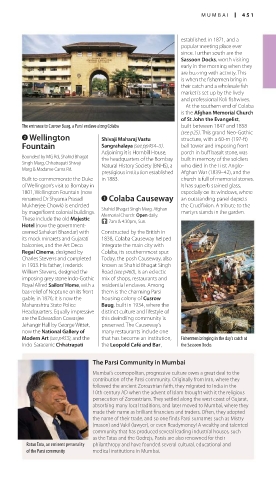
Modern Art (see p453), and the that has become an institution, Fishermen bringing in the day’s catch at
Indo-Saracenic Chhatrapati the Leopold Café and Bar , the Sassoon Docks
The Parsi Community in Mumbai
Mumbai’s cosmopolitan, progressive culture owes a great deal to the
contribution of the Parsi community. Originally from Iran, where they
followed the ancient Zoroastrian faith, they migrated to India in the
10th century AD when the advent of Islam brought with it the religious
persecution of Zoroastrians. They settled along the west coast of Gujarat,
absorbing many local traditions, and later moved to Mumbai, where they
made their name as brilliant financiers and traders. Often, they adopted
the name of their trade, and so one finds Parsi surnames such as Mistry
(mason) and Vakil (lawyer), or even Readymoney! A wealthy and talented
community that has produced several leading industrial houses, such
as the Tatas and the Godrejs, Parsis are also renowned for their
Ratan Tata, an eminent personality philanthropy and have founded several cultural, educational and
of the Parsi community medical institutions in Mumbai.
450-451_EW_India.indd 451 26/04/17 11:54 am

