


Page 458 - (DK Eyewitness) Travel Guide - India
P. 458
456 SOUTHWESTERN INDIA
The elegant circle of Neo-
Classical buildings around the
garden was built in the 1860s,
and fashioned after acclaimed
English examples such as the
Royal Crescent in Bath. Designed
by James Scott, the buildings
around the garden share a
uniform façade with pedestrian
arcades and decorative terracotta
keystones from England, and
represent the earliest planned
urban compositions in Mumbai.
The Asiatic Society of Mumbai
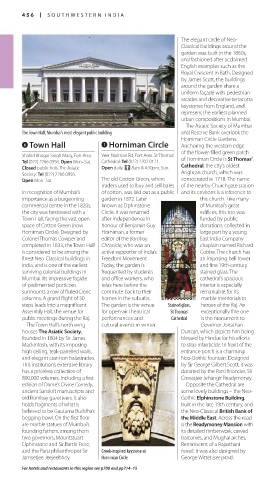
The Town Hall, Mumbai’s most elegant public building and Reserve Bank overlook the
Horniman Circle Gardens.
6 Town Hall 7 Horniman Circle Anchoring the western edge
of the flower-filled green patch
Shahid Bhagat Singh Marg, Fort Area. Veer Nariman Rd, Fort Area. St Thomas’
Tel (022) 2266 0956. Open Mon–Sat. Cathedral: Tel (022) 2202 0121. of Horniman Circle is St Thomas’
Closed public hols. The Asiatic Open daily. 5 8am & 4:30pm, Sun. Cathedral, the city’s oldest
Society: Tel (022) 2266 0956. Anglican church, which was
Open Mon–Sat. The old Cotton Green, where consecrated in 1718. The name
traders used to buy and sell bales of the nearby Churchgate station
In recognition of Mumbai’s of cotton, was laid out as a public and its environs is a reference to
importance as a burgeoning garden in 1872. Later this church. Like many
commercial centre in the 1820s, known as Elphinstone of Mumbai’s great
the city was bestowed with a Circle, it was renamed edifices, this too was
Town Hall, facing the vast open after Independence in funded by public
space of Cotton Green (now honour of Benjamin Guy donations, collected in
Horniman Circle). Designed by Horniman, a former large part by a young
Colonel Thomas Cowper and editor of the Bombay East India Company
completed in 1833, the Town Hall Chronicle, who was an chaplain named Richard
is considered to be among the active supporter of India’s Cobbe. The church has
finest Neo-Classical buildings in Freedom Movement. an imposing bell tower
India, and is one of the earliest Today, the garden is and fine 19th-century
surviving colonial buildings in frequented by students stained glass. The
Mumbai. Its impressive façade and office workers, who cathedral’s spacious
of pedimented porticoes relax here before the interior is especially
surmounts a row of fluted Doric commute back to their remarkable for its
columns. A grand flight of 30 homes in the suburbs. marble memorials to
steps leads into a magnificent The garden is the venue Stained glass, heroes of the Raj. An
Assembly Hall, the venue for for open-air theatrical St Thomas’ exceptionally fine one
public meetings during the Raj. performances and Cathedral is the monument to
The Town Hall’s north wing cultural events in winter. Governor Jonathan
houses The Asiatic Society, Duncan, which depicts him being
founded in 1804 by Sir James blessed by Hindus for his efforts
Mackintosh, with its imposing to stop infanticide. In front of the
high ceiling, teak-panelled walls, entrance porch is a charming
and elegant cast-iron balustrades. Neo-Gothic fountain. Designed
This institution’s extensive library by Sir George Gilbert Scott, it was
has a priceless collection of donated by the Parsi financier, Sir
800,000 volumes, including a first Cowasjee Jehangir Readymoney.
edition of Dante’s Divine Comedy, Opposite the Cathedral are
ancient Sanskrit manuscripts and some lovely buildings – the Neo-
old Bombay gazetteers. It also Gothic Elphinstone Building,
holds fragments of what is built in the late 19th century, and
believed to be Gautama Buddha’s the Neo-Classical British Bank of
begging bowl. On the first floor the Middle East. Across the road
are marble statues of Mumbai’s is the Readymoney Mansion with
founding fathers, among them its detailed timberwork, carved
two governors, Mountstuart balconies, and Mughal arches.
Elphin stone and Sir Bartle Frere, Reminiscent of a Rajasthani
and the Parsi philanthropist Sir Greek-inspired keystone at haveli, it was also designed by
Jamsetjee Jeejeebhoy. Horniman Circle George Wittet (see p454).
For hotels and restaurants in this region see p700 and pp714–15
456-457_EW_India.indd 456 26/04/17 11:47 am
Eyewitness Travel LAYERS PRINTED:
Catalogue template “UK” LAYER
(Source v2.6)
Date 12th July 2013
Size 125mm x 217mm

