


Page 541 - (DK Eyewitness) Travel Guide - India
P. 541
K ARNA T AK A 539
Performing Arts of Karnataka
Karnataka has a rich and vibrant performing arts tradition. Story telling, with the help
of media such as paintings and leather puppets, was among the most popular folk
entertainments in the northern and northeastern part of the state, and in neighbouring
Andhra Pradesh, before the advent of the cinema. Itinerant folk performers would
delight rural audiences with stirring tales of good and evil, based on mythological
episodes. A number of dance-dramas, such as the Yakshagana, developed in South
Kanara, the region of Karnataka that borders Kerala. As in Kathakali (see p661),
Yakshagana actors dress in awe-inspiring costumes to perform a heavily mimetic
dance, while the singer recites the story to the accompaniment of music.
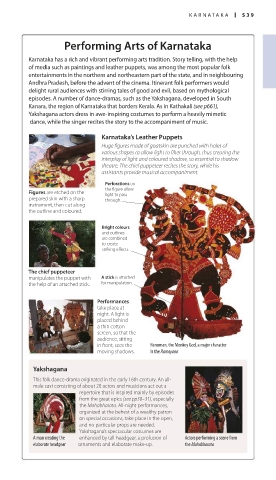
Karnataka’s Leather Puppets
Huge figures made of goatskin are punched with holes of
various shapes to allow light to filter through, thus creating the
interplay of light and coloured shadow, so essential to shadow
theatre. The chief puppeteer recites the story, while his
assistants provide musical accompaniment.
Perforations on
the figure allow
Figures are etched on the light to pass
prepared skin with a sharp through.
instrument, then cut along
the outline and coloured.
Bright colours
and outlines
are combined
to create
striking effects.
The chief puppeteer
manipulates the puppet with A stick is attached
the help of an attached stick. for manipulation.
Performances
take place at
night. A light is
placed behind
a thin cotton
screen, so that the
audience, sitting
in front, sees the Hanuman, the Monkey God, a major character
moving shadows. in the Ramayana
Yakshagana
This folk dance-drama originated in the early 16th century. An all-
male cast consisting of about 20 actors and musicians act out a
repertoire that is inspired mainly by episodes
from the great epics (see pp30–31), especially
the Mahabharata. All-night performances,
organized at the behest of a wealthy patron
on special occasions, take place in the open,
and no particular props are needed.
Yakshagana’s spectacular costumes are
A man creating the enhanced by tall headgear, a profusion of Actors performing a scene from
elaborate headgear ornaments and elaborate make-up. the Mahabharata
538-539_EW_India.indd 539 26/04/17 11:48 am

