


Page 567 - (DK Eyewitness) Travel Guide - India
P. 567
CHENNAI 565
barracks for regiments. Near the (16 miles) out at sea. The
southeast corner of the Parade adjacent red-brick High
Ground is the Fort Museum, Court, designed by Robert
built in the 1780s. A treasure Chisholm in the Indo-
trove of colonial memorabilia, Saracenic style, with stained
the museum is housed in what glass and carved furniture,
was built to be the Public was opened in 1892, while
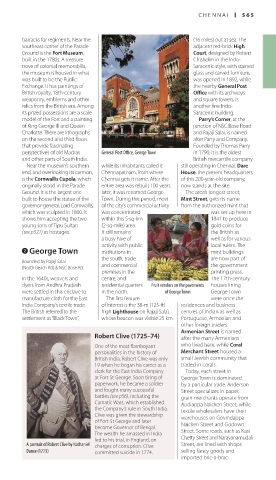
Exchange. It has paintings of the nearby General Post
British royalty, 18th-century Office with its archways
weaponry, emblems and other and square towers, is
relics from the British era. Among another fine Indo-
its prized possessions are a scale Saracenic building.
model of the Fort and a painting Parry’s Corner, at the
of King George III and Queen junction of NSC Bose Road
Charlotte. There are lithographs and Rajaji Salai, is named
on the second and third floors after Parry and Company.
that provide fascinating Founded by Thomas Parry
perspectives of old Madras General Post Office, George Town in 1790, it is the oldest
and other parts of South India. British mercantile company
Near the museum’s southern while its inhabitants called it still operating in Chennai. Dare
end, and overlooking its cannon, Chennapatnam, from where House, the present headquarters
is the Cornwallis Cupola, which Chennai gets it name. After the of this 200-year-old company,
originally stood in the Parade entire area was rebuilt 100 years now stands at the site.
Ground. It is the largest one later, it was renamed George The area’s longest street,
built to house the statue of the Town. During this period, most Mint Street, gets its name
governor-general, Lord Cornwallis, of the city’s commercial activity from the authorized mint that
which was sculpted in 1800. It was concentrated was set up here in
shows him accepting the two within this 5-sq-km 1841 to produce
young sons of Tipu Sultan (2-sq-mile) area. gold coins for
(see p521) as hostages. It still remains the British as
a busy hive of well as for various
activity with public local rulers. The
2 George Town institutions in mint buildings
the south, trade are now part of
Bounded by Rajaji Salai
(North Beach Rd) & NSC Bose Rd. and commercial the government
premises in the printing press.
In the 1640s, weavers and centre, and The 17th-century
dyers from Andhra Pradesh residential quarters Fruit vendors on the pavements houses lining
were settled in this enclave to in the north. of George Town George Town
manufacture cloth for the East The first feature were once the
India Company’s textile trade. of interest is the 38-m (125-ft) residences and business
The British referred to the high Lighthouse on Rajaji Salai, centres of Indian as well as
settlement as “Black Town”, whose beacon was visible 25 km Portuguese, Armenian and
other foreign traders.
Armenian Street is named
Robert Clive (1725–74) after the many Armenians
One of the most flamboyant who lived here, while Coral
personalities in the history of Merchant Street housed a
British India, Robert Clive was only small Jewish community that
19 when he began his career as a traded in corals.
clerk for the East India Company Today, each street in
at Fort St George. Soon tiring of George Town is dominated
paperwork, he became a soldier by a particular trade. Anderson
and fought many successful Street specializes in paper,
battles (see p56), including the grain merchants operate from
Carnatic Wars, which established Audiappa Naicken Street, while
the Company’s rule in South India. textile whole salers have their
Clive was given the stewardship warehouses on Govindappa
of Fort St George and later Naicken Street and Godown
become Governor of Bengal.
The wealth he amassed in India Street. Some roads, such as Kasi
led to his trial, in England, on Chetty Street and Narayanamudali
A portrait of Robert Clive by Nathaniel charges of corruption. Clive Street, are lined with shops
Dance (1773) committed suicide in 1774. selling fancy goods and
imported bric-a-brac.
564-565_EW_India.indd 565 26/04/17 11:48 am

