


Page 571 - (DK Eyewitness) Travel Guide - India
P. 571
CHENNAI 569
joined together to form a
holistic entity. Bronzes of other
gods and goddesses in the
Hindu pantheon, include Rama,
Sita and Ganesha. The panorama
of images also includes various
Buddhist bronzes from
Amravati, a Chola Tara and
Maitreya Avalokitesvara, and
11th-century images of various
Jain tirthankaras.
Opposite is the imposing
Connemara Public Library,
inaugurated in 1896. This
structure, with its profuse
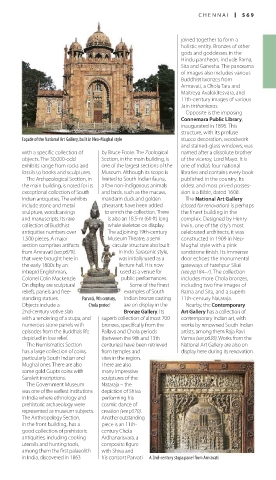
Façade of the National Art Gallery, built in Neo-Mughal style stucco decoration, woodwork
and stained-glass windows, was
with a specific collection of by Bruce Foote. The Zoological named after a dissolute brother
objects. The 30,000-odd Section, in the main building, is of the viceroy, Lord Mayo. It is
exhibits range from rocks and one of the largest sections of the one of India’s four national
fossils to books and sculptures. Museum. Although its scope is libraries and contains every book
The Archaeological Section, in limited to South Indian fauna, published in the country. Its
the main building, is noted for its a few non-indigenous animals oldest and most prized posses-
exceptional collection of South and birds, such as the macaw, sion is a Bible, dated 1608.
Indian antiquities. The exhibits mandarin duck and golden The National Art Gallery
include stone and metal pheasant, have been added (closed for renovation) is perhaps
sculpture, woodcarvings to enrich the collection. There the finest building in the
and manuscripts. Its rare is also an 18.5-m (61-ft) long complex. Designed by Henry
collection of Buddhist whale skeleton on display. Irwin, one of the city’s most
antiquities numbers over The adjoining 19th-century celebrated architects, it was
1,500 pieces. A major Museum Theatre, a semi- constructed in 1909 in Neo-
section comprises artifacts circular structure also built Mughal style with a pink
from Amravati (see p679), in Indo-Saracenic style, sandstone finish. Its immense
that were brought here in was initially used as a door echoes the monumental
the early 1800s by an lecture hall. It is now gateways of Fatehpur Sikri
intrepid Englishman, used as a venue for (see pp184–7). The collection
Colonel Colin Mackenzie. public performances. includes more Chola bronzes,
On display are sculptural Some of the finest including two fine images of
reliefs, panels and free- examples of South Rama and Sita, and a superb
standing statues. Parvati, 9th century, Indian bronze casting 11th-century Nataraja.
Objects include a Chola period are on display in the Nearby, the Contemporary
2nd-century votive slab Bronze Gallery. Its Art Gallery has a collection of
with a rendering of a stupa, and superb collection of almost 700 contemporary Indian art, with
numerous stone panels with bronzes, specif ically from the works by renowned South Indian
episodes from the Buddha’s life Pallava and Chola periods artists, among them Raja Ravi
depicted in low relief. (between the 9th and 13th Varma (see p630). Works from the
The Numismatics Section centuries) have been retrieved National Art Gallery are also on
has a large collection of coins, from temples and display here during its renovation.
particularly South Indian and sites in the region.
Mughal ones. There are also There are also
some gold Gupta coins with many impressive
Sanskrit inscriptions. sculptures of the
The Government Museum Nataraja – the
was one of the earliest institutions depiction of Shiva
in India where ethnology and performing his
prehistoric archaeology were cosmic dance of
represented as museum subjects. creation (see p570).
The Anthropology Section, Another outstanding
in the front building, has a piece is an 11th-
good collection of prehistoric century Chola
antiquities, including cooking Ardhanarisvara, a
utensils and hunting tools, composite figure
among them the first palaeolith with Shiva and
in India, discovered in 1863 his consort Parvati A 2nd-century stupa panel from Amravati
568-569_EW_India.indd 569 26/04/17 11:48 am

