


Page 579 - (DK Eyewitness) Travel Guide - India
P. 579
CHENNAI 577
include crocodiles, turtles and
lizards. Large information boards
provide interesting details on
the habitat and behaviour of the
various species. For those who
are interested, there are live
demonstrations of venom
extraction; the venom is used
as an antidote for snake bites.
The historic 300-year-old
Guindy Lodge, to the west of
the Park, is now the Raj Bhavan,
the residence of the governor of
Tamil Nadu. Built as a weekend
retreat for the city’s British rulers,
this handsome white building
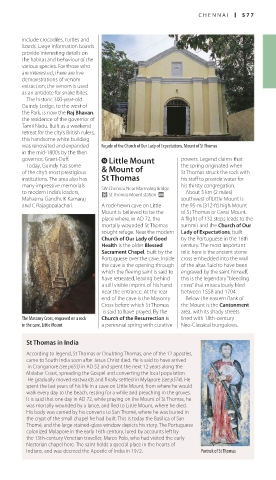
was renovated and expanded Façade of the Church of Our Lady of Expectations, Mount of St Thomas
in the mid-1800s by the then
governor, Grant-Duff. r Little Mount powers. Legend claims that
Today, Guindy has some & Mount of the spring originated when
of the city’s most prestigious St Thomas struck the rock with
institutions. The area also has St Thomas his staff to provide water for
many impressive memorials SW Chennai. Near Marmalog Bridge. his thirsty congregation.
to modern India’s leaders, £ St Thomas Mount station. @ About 3 km (2 miles)
Mahatma Gandhi, K Kamaraj southwest of Little Mount is
and C Rajagopalachari. A rock-hewn cave on Little the 95-m (312-ft) high Mount
Mount is believed to be the of St Thomas or Great Mount.
place where, in AD 72, the A flight of 132 steps leads to the
mortally wounded St Thomas summit and the Church of Our
sought refuge. Near the modern Lady of Expectations, built
Church of Our Lady of Good by the Portuguese in the 16th
Health is the older Blessed century. The most important
Sacrament Chapel, built by the relic here is the ancient stone
Portuguese over the cave. Inside cross embedded into the wall
the cave is the opening through of the altar. Said to have been
which the fleeing saint is said to engraved by the saint himself,
have retreated, leaving behind this is the legendary “bleeding
a still visible imprint of his hand cross” that miraculously bled
near the entrance. At the rear between 1558 and 1704.
end of the cave is the Masonry Below the eastern flank of
Cross before which St Thomas the Mount is the Cantonment
is said to have prayed. By the area, with its shady streets
The Masonry Cross, engraved on a rock Church of the Resurrection is lined with 18th-century
in the cave, Little Mount a perennial spring with curative Neo-Classical bungalows.
St Thomas in India
According to legend, St Thomas or Doubting Thomas, one of the 12 apostles,
came to South India soon after Jesus Christ died. He is said to have arrived
in Cranganore (see p653) in AD 52 and spent the next 12 years along the
Malabar Coast, spreading the Gospel and converting the local population.
He gradually moved eastwards and finally settled in Mylapore (see p574). He
spent the last years of his life in a cave on Little Mount, from where he would
walk every day to the beach, resting for a while and preaching in the groves.
It is said that one day in AD 72, while praying on the Mount of St Thomas, he
was mortally wounded by a lance, and fled to Little Mount, where he died.
His body was carried by his converts to San Thomé, where he was buried in
the crypt of the small chapel he had built. This is today the Basilica of San
Thomé, and the large stained-glass window depicts his story. The Portuguese
colonized Mylapore in the early 16th century, lured by accounts left by
the 13th-century Venetian traveller, Marco Polo, who had visited the early
Nestorian chapel here. The saint holds a special place in the hearts of
Indians, and was decreed the Apostle of India in 1972. Portrait of St Thomas
576-577_EW_India.indd 577 26/04/17 11:55 am

