


Page 629 - (DK Eyewitness) Travel Guide - India
P. 629
AND A M AN ISLANDS 627
8 Middle Andaman
Middle Andaman Island. 170 km (106
miles) N from Port Blair to Rangat. g
from Port Blair. Travel permits: required
for the Andamans (see pp734–5).
This is literally the middle island
among the Andamans trio.
Large tracts of its interior are
part of the highly protected
Jarawa Tribal Reserve. The
Jarawas, traditional hunter-
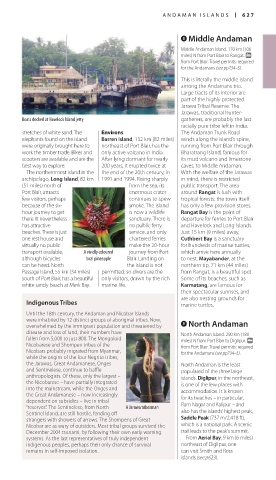
Boats docked at Havelock Island jetty gatherers, are probably the last
racially pure tribe left in India.
stretches of white sand. The Environs The Andaman Trunk Road
elephants found on the island Barren Island, 132 km (82 miles) winds along the island’s spine,
were originally brought here to northeast of Port Blair, has the running from Port Blair through
work the timber trade. Bikes and only active volcano in India. Bharatrang Island, famous for
scooters are available and are the After lying dormant for nearly its mud volcano and limestone
best way to explore. 200 years, it erupted twice at caves, to Middle Andaman.
The northernmost island in the the end of the 20th century, in With the welfare of the Jarawas
archipelago, Long Island, 82 km 1991 and 1994. Rising sharply in mind, there is restricted
(51 miles) north of from the sea, its public transport. The area
Port Blair, attracts enormous crater around Rangat is lush with
few visitors, perhaps continues to spew tropical forests; the town itself
because of the six- smoke. The island has only a few provision stores.
hour journey to get is now a wildlife Rangat Bay is the point of
there. It nevertheless sanctuary. There is departure for ferries to Port Blair
has attractive no public ferry and Havelock and Long Islands.
beaches. There is just service, and only Just 15 km (9 miles) away,
one rest house and chartered ferries Cuthbert Bay is a sanctuary
virtually no public make the 20-hour for hundreds of marine turtles,
transport available, A vividly coloured journey from Port which arrive here annually
although bicycles local pineapple Blair. Landing on to nest. Mayabander, at the
can be hired. North the island is not northern tip, 71 km (44 miles)
Passage Island, 55 km (34 miles) permitted, so divers are the from Rangat, is a beautiful spot.
south of Port Blair, has a beautiful only visitors, drawn by the rich Some of its beaches, such as
white sandy beach at Merk Bay. marine life. Karmatang, are famous for
their spectacular sunrises, and
are also nesting grounds for
Indigenous Tribes marine turtles.
Until the 18th century, the Andaman and Nicobar Islands
were inhabited by 12 distinct groups of aboriginal tribes. Now, 9 North Andaman
overwhelmed by the immigrant population and threatened by
disease and loss of land, their numbers have North Andaman Island. 290 km (180
fallen from 5,000 to just 800. The Mongoloid miles) N from Port Blair to Diglipur. g
Nicobarese and Shompen tribes of the from Port Blair. Travel permits: required
Nicobars probably migrated from Myanmar, for the Andamans (see pp734–5).
while the origins of the four Negrito tribes,
the Jarawas, Great Andamanese, Onges North Andaman is the least
and Sentinelese, continue to baffle populated of the three large
anthropologists. Of these, only the largest – islands. Diglipur, in the northeast,
the Nicobarese – have partially integrated is one of the few places with
into the mainstream, while the Onges and accommodation. It is known
the Great Andamanese – now increasingly for its beaches – in particular,
dependent on subsidies – live in tribal
“reserves”. The Sentinelese, from North A Jarawa tribesman Ram Nagar and Kalipur – and
Sentinel Island, are still hostile, fending off also has the islands’ highest peak,
strangers with showers of arrows. The Shompens of Great Saddle Peak (737 m/2,418 ft),
Nicobar are as wary of outsiders. Most tribal groups survived the which is a national park. A scenic
December 2004 tsunami, by following their own early warning trail leads to the peak’s summit.
systems. As the last representatives of truly independent From Aerial Bay, 9 km (6 miles)
indigenous peoples, perhaps their only chance of survival northeast of Diglipur, one
remains in self-imposed isolation. can visit Smith and Ross
islands (see p623).
626-627_EW_India.indd 627 26/04/17 11:55 am

