


Page 655 - (DK Eyewitness) Travel Guide - India
P. 655
KER ALA 653
t Kodungallur
Thrissur district. 32 km (20 miles) N of
Kochi. @ _ Id (Feb/Mar), Bharani
Festival (Mar/Apr).
Known as Muziris to the
Greeks, and Cranganore to the
Europeans, Kodungallur was the
historic capital of the Cheraman
Perumals, monarchs of the
Chera empire (see p47). Situated
at the mouth of the Periyar river,
this was the Malabar Coast’s
main port until a flood tide in
1341 silted up the harbour. After
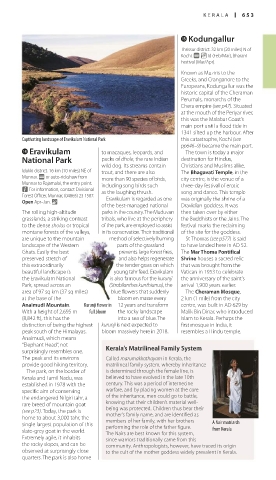
Captivating landscape of Eravikulam National Park this catastrophe, Kochi (see
pp646–9) became the main port.
r Eravikulam to macaques, leopards, and The town is today a major
National Park packs of dhole, the rare Indian destination for Hindus,
wild dog. Its streams contain Christians and Muslims alike.
Idukki district. 16 km (10 miles) NE of trout, and there are also The Bhagavati Temple, in the
Munnar. @ or auto-rickshaw from more than 90 species of birds, city centre, is the venue of a
Munnar to Rajamalai, the entry point. including song birds such three-day festival of erotic
n For information, contact Divisional
Forest Officer, Munnar, (04865) 23 1587. as the laughing thrush. song and dance. This temple
Eravikulam is regarded as one
was originally the shrine of a
Open Apr–Jan. &
of the best-managed national Dravidian goddess. It was
The rolling high-altitude parks in the country. The Muduvan then taken over by either
grasslands, a striking contrast tribals, who live at the periphery the Buddhists or the Jains. The
to the dense sholas or tropical of the park, are employed to assist festival marks the reclaiming
montane forests of the valleys, in its conservation. Their traditional of the site for the goddess.
are unique to the mountain method of selectively burning St Thomas (see p577) is said
landscape of the Western parts of the grassland to have landed here in AD 52.
Ghats. Easily the best prevents large forest fires, The Mar Thoma Pontifical
preserved stretch of and also helps regenerate Shrine houses a sacred relic
this extra ordinarily the tender grass on which that was brought from the
beautiful landscape is young tahr feed. Eravikulam Vatican in 1953 to celebrate
the Eravikulam National is also famous for the kurunji the anniversary of the saint’s
Park, spread across an (Strobilanthes kunthianus), the arrival 1,900 years earlier.
area of 97 sq km (37 sq miles) blue flowers that suddenly The Cheraman Mosque,
at the base of the bloom en masse every 2 km (1 mile) from the city
Anaimudi Mountain. Kurunji flower in 12 years and transform centre, was built in AD 629 by
With a height of 2,695 m full bloom the rocky landscape Malik Bin Dinar, who introduced
(8,842 ft), this has the into a sea of blue. The Islam to Kerala. Perhaps the
distinction of being the highest kurunji is next expected to first mosque in India, it
peak south of the Himalayas. bloom massively here in 2018. resembles a Hindu temple.
Anaimudi, which means
“Elephant Head”, not Kerala’s Matrilineal Family System
surprisingly resembles one.
The peak and its environs Called marumakkathayam in Kerala, the
provide good hiking territory. matrilineal family system, whereby inheritance
The park, on the border of is determined through the female line, is
Kerala and Tamil Nadu, was believed to have evolved in the late 10th
established in 1978 with the century. This was a period of internecine
specific aim of conserving warfare, and by placing women at the core
the endangered Nilgiri tahr, a of the inheritance, men could go to battle,
rare breed of mountain goat knowing that their children’s material well-
(see p23). Today, the park is being was protected. Children thus bear their
home to about 3,000 tahr, the mother’s family name, and are identified as
members of her family, with her brothers
single largest population of this performing the role of the father figure. A Nair matriarch
slate-grey goat in the world. The Nairs are best known for this system, from Kerala
Extremely agile, it inhabits since warriors traditionally came from this
the rocky slopes, and can be community. Anthropologists, however, have traced its origin
observed at surprisingly close to the cult of the mother goddess widely prevalent in Kerala.
quarters. The park is also home
652-653_EW_India.indd 653 26/04/17 11:50 am

