


Page 656 - (DK Eyewitness) Travel Guide - India
P. 656
654 SOUTH INDIA
The Asian Elephant
Literature, art and culture in India celebrate the elephant. Ganesha, the elephant-
headed son of Shiva and Parvati, is the Remover of Obstacles, and his name is
invoked before any important task is undertaken (see p471). Unlike in the rest
of India, Ganesha is a minor deity in Kerala. Elephants play a major role in
the daily life and festivals of the people of Kerala, who have a uniquely close
and affectionate relationship with these animals. Though mainly used as beasts
of burden, elephants also participate in temple rituals, where they carry the deity
in sacred processions. For such occasions, elephants are splendidly caparisoned
with ornaments of gold. The wealthier temples have their own elephants.
The tusker (a
male with large
tusks) faces
great danger
from poaching,
despite the
ban on ivory.
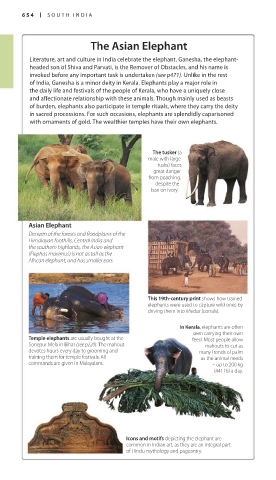
Asian Elephant
Denizen of the forests and floodplains of the
Himalayan foothills, Central India and
the southern highlands, the Asian elephant
(Elephas maximus) is not as tall as the
African elephant, and has smaller ears.
This 19th-century print shows how trained
elephants were used to capture wild ones by
driving them into khedas (corrals).
In Kerala, elephants are often
seen carrying their own
Temple elephants are usually bought at the feed. Most people allow
Sonepur Mela in Bihar (see p220). The mahout mahouts to cut as
devotes hours every day to grooming and many fronds of palm
training them for temple festivals. All as the animal needs
commands are given in Malayalam. – up to 200 kg
(441 lb) a day.
Icons and motifs depicting the elephant are
common in Indian art, as they are an integral part
of Hindu mythology and pageantry.
654-655_EW_India.indd 654 26/04/17 11:55 am

