


Page 70 - (DK Eyewitness) Travel Guide - India
P. 70
68 DELHI & THE NOR TH
The Great Himalayas
C H I N A
The highest and youngest mountains in the world, the PAKISTAN
Himalayan Range stretches for 2,500 km (1,553 miles) NEPAL BHUTAN
along the Indian subcontinent’s northern borders,
separating it from Central Asia and the Tibetan Plateau. INDIA
The Himalayas were formed about 30 million years BANGLADESH
ago, when the Indian plate broke away from
Gondwanaland, drifted northwards and collided with Locator Map
the Eurasian landmass, driving the earth’s crust up to The Himalayas
form three parallel ranges, which include 30 of the Area illustrated below
world’s highest peaks.
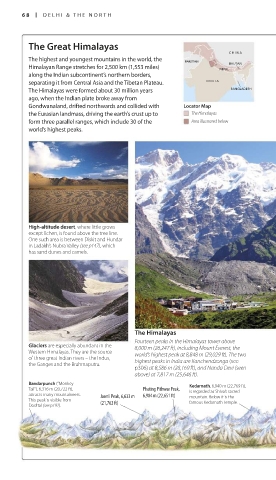
High-altitude desert, where little grows
except lichen, is found above the tree line.
One such area is between Diskit and Hundar
in Ladakh’s Nubra Valley (see p147), which
has sand dunes and camels.
The Himalayas
Fourteen peaks in the Himalayas tower above
Glaciers are especially abundant in the 8,000 m (26,247 ft), including Mount Everest, the
Western Himalayas. They are the source world’s highest peak at 8,848 m (29,029 ft). The two
of three great Indian rivers – the Indus, highest peaks in India are Kanchendzonga (see
the Ganges and the Brahmaputra.
p306) at 8,586 m (28,169 ft), and Nanda Devi (seen
above) at 7,817 m (25,646 ft).
Bandarpunch (“Monkey Kedarnath, 6,940 m (22,769 ft),
Tail”), 6,316 m (20,722 ft), Phating Pithwar Peak, is regarded as Shiva’s sacred
attracts many mountaineers. Jaonli Peak, 6,633 m 6,904 m (22,651 ft) mountain. Below it is the
This peak is visible from famous Kedarnath Temple.
Dodital (see p192). (21,762 ft)
068-069_EW_India.indd 68 26/04/17 11:53 am

