


Page 71 - (DK Eyewitness) Travel Guide - India
P. 71
INTRODUCING DELHI & THE NOR TH 69
Flora and Fauna
Subtropical jungles, temperate
coniferous forests and alpine
meadows are among the
varied vegetation zones in
the Himalayas. They support
a rich and abundant variety
of plant and animal life.
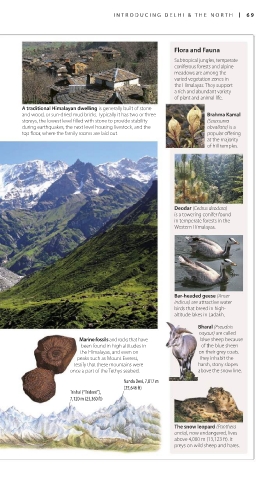
A traditional Himalayan dwelling is generally built of stone
and wood, or sun-dried mud bricks. Typically it has two or three Brahma Kamal
storeys, the lowest level filled with stone to provide stability (Saussurea
during earthquakes, the next level housing livestock, and the obvallata) is a
top floor, where the family rooms are laid out. popular offering
at the majority
of hill temples.
Deodar (Cedrus deodara)
is a towering conifer found
in temperate forests in the
Western Himalayas.
Bar-headed geese (Anser
indicus) are attractive water
birds that breed in high-
altitude lakes in Ladakh.
Bharal (Pseudois
nayaur) are called
Marine fossils and rocks that have blue sheep because
been found in high altitudes in of the blue sheen
the Himalayas, and even on on their grey coats.
peaks such as Mount Everest, They inhabit the
testify that these mountains were harsh, stony slopes
once a part of the Tethys seabed. above the snow line.
Nanda Devi, 7,817 m
(25,646 ft)
Trishul (“Trident”),
7,120 m (23,360 ft)
The snow leopard (Panthera
uncia), now endangered, lives
above 4,000 m (13,123 ft). It
preys on wild sheep and hares.
068-069_EW_India.indd 69 26/04/17 11:53 am

