


Page 117 - (DK Eyewitness) Travel Guide: Japan
P. 117
ENTER T AINMENT IN T OK Y O 115
(see pp102–3), the city’s upscale
playground, is one of the most
lively. The Roi Building (see The
Pink Cow, under “Live Music”)
across the road from Don
Quijote is full of clubs and bars.
The Ni-chome area of Shinjuku
is home to some 250 gay clubs,
as well as numerous pubs and
bars. Many famous DJs operate
at AgeHa, Tokyo’s largest
nightclub, in Shin-kiba. Atom,
in Shibuya, attracts a mainly
young clientele and has two
dance floors as well as a floor
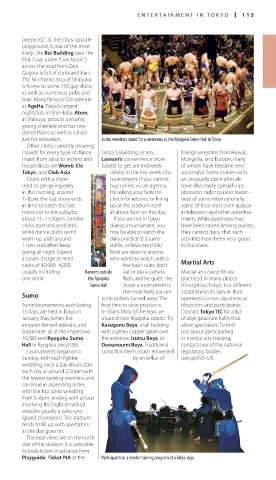
just for relaxation. Sumo wrestlers stand for a ceremony at the Ryogoku Sumo Hall in Tokyo
Other clubs currently drawing
crowds for every type of dance Ginza 5 Building, or any foreign wrestlers from Hawaii,
music from salsa to techno and Lawson’s convenience store. Mongolia, and Europe, many
house disco are Womb, Ele Easiest to get are midweek of whom have become very
Tokyo, and Club Asia. tickets in the first week of a successful. Some stables with
Clubs with a show tournament. If you cannot an unusually open attitude
tend to get going early buy tickets via an agency, have also made special trips
in the evening, around try asking your hotel to abroad in order to raise aware-
7–8pm; the last show ends check for returns, or lining ness of sumo inter nationally;
in time to catch the last up at the stadium itself some of their stars even appear
trains out to the suburbs, at about 8am on the day. in television and other advertise-
about 11–11:30pm. Smaller If you are not in Tokyo ments. While eyebrows may
clubs start and end later, during a tournament, you have been raised among purists,
while dance clubs won’t may be able to watch the they cannot deny that such
warm up until around daily practice at a sumo activities have been very good
11pm and often keep stable, or beya (see p106). for business.
going all night. Expect Most are open to anyone
a cover charge at most who wants to watch, with a Martial Arts
clubs of ¥2,000–4,000, few basic rules: don’t
usually including Banners outside eat or use a camera Martial arts (see p39) are
one drink. the Ryogoku flash, and be quiet. The practiced in many places
Sumo Hall closer a tournament is, throughout Tokyo, but different
the more likely you are establishments vary in their
Sumo
to be politely turned away. The openness to non-Japanese as
Sumo tournaments, each lasting best time to view practice is observers and participants.
15 days, are held in Tokyo in 6–10am. Most of the beya are Contact Tokyo TIC for a list
January, May (when the situated near Ryogoku station. Try of dojo (practice halls) that
emperor himself attends), and Kasu gano Beya, a tall building allow spectators. To find
September, all at the impressive with a green copper gable over out about partici pating
10,000-seat Ryogoku Sumo the en trance, Izutsu Beya, or in martial arts training,
Hall in Ryogoku (see p106). Dewanoumi Beya. Traditional contact one of the national
Tournaments begin on a sumo has been much enlivened regulatory bodies
Sunday, with each fighter by an influx of (see pp350–53).
wrestling once a day. Bouts start
each day at around 2:30pm with
the lowest-ranking wrestlers and
continue in ascending order,
with the top ranks wrestling
from 5–6pm, ending with a bout
involving the highest-ranked
wrestler, usually a yokozuna
(grand champion). The stadium
tends to fill up with spectators
as the day goes on.
The best views are on the north
side of the stadium. It is advisable
to book tickets in advance from
Playguide, Ticket PIA at the Participants in a kendo training program at a Tokyo dojo
114-115_EW_Japan.indd 115 08/08/16 3:06 pm

