


Page 135 - (DK Eyewitness) Travel Guide: Japan
P. 135
JAP AN REGION B Y REGION 133
CENTRAL HONSHU
Lying between Tokyo and Kyoto, Central Honshu epitomizes the contrasts
of Japan today. Its densely populated coastal belt includes the country’s
second- and fourth-largest cities, while the interior contains its highest,
wildest mountains. Between these extremes, much of the region is relatively
accessible, yet remote enough to have kept traditional rural lifestyles,
architecture, and festivals.
The mountains of Central Honshu Among the latter, the post towns of Kiso
incorporate not only Mount Fuji but and thatched villages of Shokawa have
also the North and South Japan Alps, found new life in tourism thanks to
with many peaks over 3,000 m (10,000 unspoiled archi tecture, while Takayama
ft). They dictate the area’s character, and Chichibu attract thousands to their
and offer hiking, skiing, and hot springs. festivals. The former regional capitals
During the Edo period (1603–1868) of Kamakura and Kanazawa maintain
five post roads crossed the region, two tradition in gardens, temples, and crafts.
of which linked Edo (Tokyo) and Kyoto. The region produces skilled woodwork:
Feudal lords were required to spend half lacquerware in Takayama, Noto, and
their time in Edo, so long processions Kiso; carving in Kamakura; yosegi-zaiku
traveled the roads, and checkpoints (Japanese parquetry) in Hakone. Until the
and post towns grew up. Most heavily 1970s, silkworms were raised in Shokawa
used were the Tokaido via Yokohama, and Chichibu; silk is still dyed in Kanazawa.
Hakone, and Shizuoka, and the Central Honshu cuisine focuses on
Nakasendo through the Kiso Valley. seafood coastally, while moun tain
Remnants of both can be walked. fare com prises river fish, sansai (wild
Today there is a dramatic contrast vege tables), tofu, and miso. Kanazawa’s
between the urban Pacific coast, refined yet down-to-earth Kaga ryori
including Yokohama and Nagoya, uses fish and duck; Nagoya is known
and underpopulated rural areas. for eel, chicken, and stronger flavors.
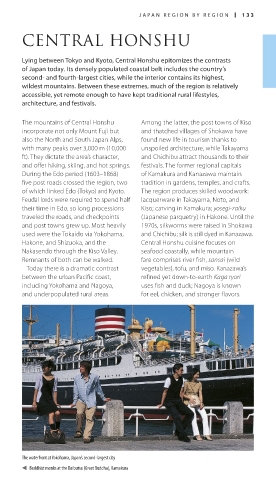
The waterfront at Yokohama, Japan’s second-largest city
Buddhist monks at the Daibutsu (Great Buddha), Kamakura
132-133_EW_Japan.indd 133 08/08/16 3:06 pm

