


Page 142 - (DK Eyewitness) Travel Guide: Japan
P. 142
140 JAP AN REGION B Y REGION
Exploring Kita Kamakura (at their peak in June), there are
irises; these bloom in late May,
Zen Buddhism came to Japan from China at the end of the when the rear garden, usually
12th century. Its simplicity and accessibility appealed to the only tantalizingly glimpsed
ethos of Kamakura samurai warriors as well as to ordi nary through a round win dow, is
people. Kita (north) Kamakura, a tranquil area of wooded opened to the public.
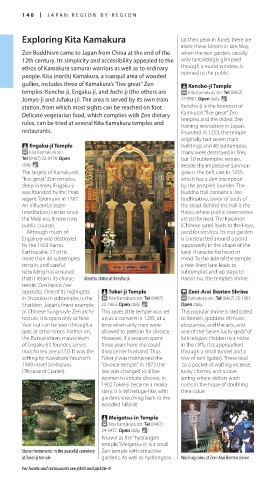
gullies, includes three of Kama kura’s “five great” Zen Kencho-ji Temple
temples: Kencho-ji, Engaku-ji, and Jochi-ji (the others are £ Kita Kamakura stn. Tel (0467)
Jomyo-ji and Jufuku-ji). The area is served by its own train 22-0981. Open daily. &
station, from which most sights can be reached on foot. Kencho-ji is the foremost of
Delicate vegetarian food, which complies with Zen dietary Kamkura’s “five great” Zen
temples and the oldest Zen
rules, can be tried at several Kita Kamakura temples and training monastery in Japan.
restaurants. Founded in 1253, the temple
originally had seven main
Engaku-ji Temple buildings and 49 subtemples;
£ Kita Kamakura stn. many were destroyed in fires,
Tel (0467) 22-0478. Open but 10 subtemples remain.
daily. & Beside the impressive Sanmon
The largest of Kama kura’s gate is the bell, cast in 1255,
“five great” Zen temples, which has a Zen inscription
deep in trees, Engaku-ji by the temple’s founder. The
was founded by the Hojo Buddha Hall contains a Jizo
regent Tokimune in 1282. bodhisattva, savior of souls of
An influential zazen the dead. Behind the hall is the
(medi tation) center since Hatto, where public cere monies
the Meiji era, it now runs are performed. The Karamon
public courses. (Chinese gate) leads to the Hojo,
Although much of used for services. Its rear garden
Engaku-ji was destroyed is constructed around a pond
by the 1923 Kanto supposedly in the shape of the
Earthquake, 17 of its kanji character for heart or
more than 40 subtemples mind. To the side of the temple
remain, and careful a tree-lined lane leads to
re building has ensured subtemples and up steps to
that it retains its charac- Bosatsu statue at Kencho-ji Hanso-bo, the temple’s shrine.
teristic Zen layout (see
opposite). One of its highlights, Tokei-ji Temple Zeni-Arai Benten Shrine
in Shozoku-in subtemple, is the £ Kita Kamakura stn. Tel (0467) £ Kamakura stn. Tel (0467) 25-1081.
Shariden. Japan’s finest example 22-1663. Open daily. & Open daily.
of Chinese Sung-style Zen archi- This quiet little temple was set This popular shrine is dedi cated
tecture, it is open only at New up as a convent in 1285, at a to Benten, goddess of music,
Year but can be seen through a time when only men were eloquence, and the arts, and
gate at other times. Farther on, allowed to petition for divorce. one of the “seven lucky gods” of
the Butsunichian, mauso leum However, if a woman spent folk religion. Hidden in a niche
of Engaku-ji’s founder, serves three years here she could in the cliffs, it is approached
matcha tea (see p173). It was the divorce her husband. Thus through a small tunnel and a
setting for Kawabata Yasunari’s Tokei-ji was nicknamed the row of torii (gates). These lead
1949 novel Sen bazuru “divorce temple.” In 1873 the to a pocket of wafting incense,
(Thousand Cranes). law was changed to allow lucky charms, and a cave
women to initiate divorce; in spring where visitors wash
1902 Tokei-ji became a mona- coins in the hope of doubling
stery. It is still refuge-like, with their value.
gardens stretching back to the
wooded hillside.
Meigetsu-in Temple
£ Kita Kamakura stn. Tel (0467)
24-3437. Open daily. &
Known as the “hydrangea
temple,” Meigetsu-in is a small
Stone monuments in the peaceful cemetery Zen temple with attractive
at Tokei-ji temple gardens. As well as hydrangeas Washing coins at Zeni-Arai Benten shrine
For hotels and restaurants see p303 and pp326–9
140-141_EW_Japan.indd 140 08/08/16 2:53 pm

