


Page 143 - (DK Eyewitness) Travel Guide: Japan
P. 143
CENTR AL HONSHU 141
The Layout of a Zen Buddhist Temple
Japanese Zen temple layout is typically based on Chinese Sung-dynasty tem ples.
Essentially rectilinear and symmetrical (in contrast to native Japanese asym metry), Zen
temples have the main buildings in a straight line one behind another, on a roughly
north–south axis. The main buildings comprise the Sanmon (main gate), Butsuden
(Buddha Hall), Hatto lecture hall, sometimes a meditation or study hall, and the abbot’s
and monks’ quarters. In practice, sub temples often crowd around the main buildings
and may obscure the basic layout. The temple compound is entered by a bridge over
a pond or stream, symbolically crossing from the earthly world to that of Buddha.
Buildings are beautiful but natural looking, often of unpainted wood; they are intended
to be condu cive to emptying the mind of worldly illusions, facilitating enlightenment.
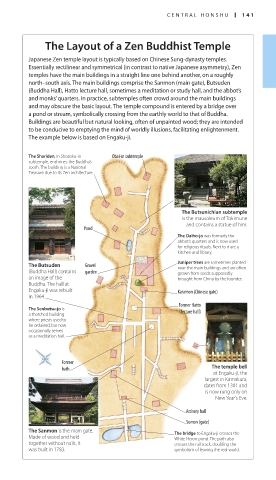
The example below is based on Engaku-ji.
The Shariden, in Shozoku-in Obai-in subtemple
subtemple, enshrines the Buddha’s
tooth. The building is a National
Treasure due to its Zen architecture.
The Butsunichian subtemple
is the mausoleum of Tokimune
and contains a statue of him.
Pond
The Daiho-jo was formerly the
abbot’s quarters and is now used
for religious rituals. Next to it are a
kitchen and library.
Juniper trees are sometimes planted
The Butsuden Gravel near the main buildings and are often
(Buddha Hall) contains garden grown from seeds supposedly
an image of the brought from China by the founder.
Buddha. The hall at
Engaku-ji was rebuilt Karamon (Chinese gate)
in 1964.
Former Hatto
The Senbutsu-jo is
a thatched buil ding (lecture hall)
where priests used to
be ordained, but now
occasionally serves
as a meditation hall.
Former
bath The temple bell
at Engaku-ji, the
largest in Kamakura,
dates from 1301 and
is now rung only on
New Year’s Eve.
Archery hall
Somon (gate)
The Sanmon is the main gate. The bridge to Engaku-ji crosses the
Made of wood and held White Heron pond. The path also
together without nails, it crosses the rail track, doubling the
was built in 1783. symbolism of leaving the real world.
140-141_EW_Japan.indd 141 08/08/16 2:53 pm

