


Page 153 - (DK Eyewitness) Travel Guide: Japan
P. 153
CENTR AL HONSHU 151
Gassho-zukuri Houses
These houses are named for their steep thatched roofs, shaped like gassho (“praying
hands”). The climate demands strong, steep roofs able to withstand heavy snow and
shed rain quickly so that the straw does not rot. Gassho structures meet those require
ments with a series of triangular frames on a rect angular base, creating a large interior
space. Generally three or four stories, they traditionally accommodated extended
families of 20–30 people on the ground floor, all involved in silkworm culti vation;
the upper floors housed the silkworms, permitting variations in light, heat, and air
at different stages. To maximize venti lation and light, gassho-zukuri houses have no
hipped gables, and windows at both ends are opened to allow the wind through –
in Shirakawago, where winds always blow north–south along the valley floor, all
houses are aligned on the same axis. Architectural details vary from village to village.
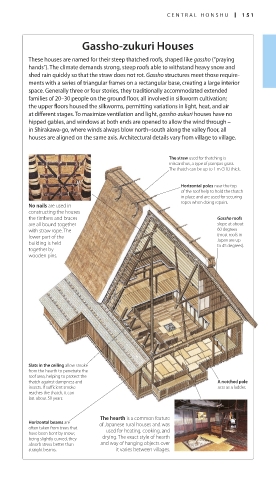
The straw used for thatching is
miscanthus, a type of pampas grass.
The thatch can be up to 1 m (3 ft) thick.
Horizontal poles near the top
of the roof help to hold the thatch
in place and are used for securing
ropes when doing repairs.
No nails are used in
constructing the houses –
the timbers and braces Gassho roofs
are all bound together slope at about
with straw rope. The 60 degrees
lower part of the (most roofs in
Japan are up
building is held to 45 degrees).
together by
wooden pins.
Slats in the ceiling allow smoke
from the hearth to penetrate the
roof area, helping to protect the
thatch against dampness and A notched pole
insects. If sufficient smoke acts as a ladder.
reaches the thatch, it can
last about 50 years.
The hearth is a common feature
Horizontal beams are of Japanese rural houses and was
often taken from trees that
have been bent by snow; used for heating, cooking, and
being slightly curved, they drying. The exact style of hearth
absorb stress better than and way of hanging objects over
straight beams. it varies between villages.
150-151_EW_Japan.indd 151 08/08/16 3:07 pm

