


Page 234 - (DK Eyewitness) Travel Guide: Japan
P. 234
232 JAP AN REGION B Y REGION
The 88-Temple Pilgrimage
The 88-Temple Pilgrimage
When pilgrims retrace the route of Kukai, the founder of
Shingon Buddhism (see p279) who made a pilgrimage of 88 of
the island’s minor temples in the 9th century, they are honoring
a cultural icon and hoping some of the magic rubs off. Those
who hope to atone for a grave error complete the pilgrimage in
reverse order; it is believed they will encounter the saint as they
walk or in their dreams. In Shingon, 88
represents the number of evils that
can beset us. About 100,000 pilgrims
complete the circuit each year;
countless others follow part of it.
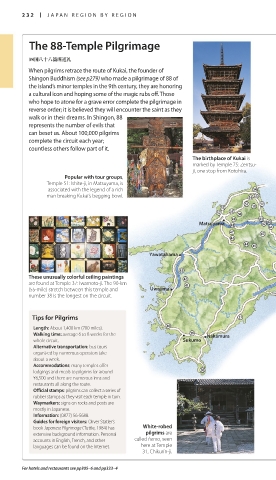
The birthplace of Kukai is
marked by Temple 75: Zentsu-
ji, one stop from Kotohira.
Popular with tour groups,
Temple 51: Ishite-ji, in Matsu yama, is
associated with the legend of a rich
man breaking Kukai’s begging bowl.
Matsuyama
Yawatahama
These unusually colorful ceiling paintings
are found at Temple 37: Iwamoto-ji. The 90-km
(55-mile) stretch between this temple and Uwajima
number 38 is the longest on the circuit.
Tips for Pilgrims
Length: About 1,400 km (700 miles).
Walking time: average 6 to 8 weeks for the Nakamura
whole circuit. Sukumo
Alternative transportation: bus tours
organized by numerous operators take
about a week.
Accommodations: many temples offer
lodgings and meals to pilgrims for around
¥6,500 and there are numerous inns and
restaurants all along the route.
Official stamps: pilgrims can collect a series of
rubber stamps as they visit each temple in turn.
Waymarkers: signs on rocks and posts are
mostly in Japanese.
Information: (0877) 56-5688.
Guides for foreign visitors: Oliver Statler’s
book Japanese Pilgrimage (Tuttle, 1984) has White-robed
extensive background information. Personal pilgrims are
accounts in English, French, and other called henro, seen
languages can be found on the Internet. here at Temple
31, Chikurin-ji.
For hotels and restaurants see pp305–6 and pp333–4
232-233_EW_Japan.indd 232 08/08/16 3:08 pm
Eyewitness Travel LAYERS PRINTED:
Feature template “UK” LAYER
(SourceReport v1.3)
Date 18th October 2012
Size 125mm x 217mm

