Page 235 - (DK Eyewitness) Travel Guide: Japan
P. 235
SHIK OKU      233


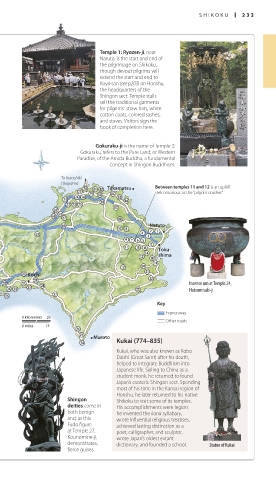
                           Temple 1: Ryozen-ji, near
                           Naruto, is the start and end of
                           the pilgrimage on Shikoku,
                           though devout pilgrims will
                           extend the start and end to
                           Koya-san (see p203) on Honshu,
                           the headquarters of the
                           Shingon sect. Temple stalls
                           sell the traditional garments
                           for pilgrims: straw hats, white
                           cotton coats, colored sashes,
                           and staves. Visitors sign the
                           book of completion here.

                          Gokuraku-ji is the name of Temple 2:
                      Gokuraku, refers to the Pure Land, or Western
                     Paradise, of the Amida Buddha, a fundamental
                             concept in Shingon Buddhism.
                 To Kurashiki
                 Okayama
                                         Between temples 11 and 12 is an uphill
                             Takamatsu •
                                         trek notorious as the “pilgrim crusher.”


                                       Naruto
                                           •
                                          •
                                          Toku-
                                          shima

        Kochi
                                                  Incense urn at Temple 24,
                                                  Hotsumisaki-ji
                                         Key
                                            Expressway
       0 kilometers  25
                                            Other roads
       0 miles  15
                          Muroto
                               Kukai (774–835)
                               Kukai, who was also known as Kobo
                               Daishi (Great Saint) after his death,
                               helped to integrate Buddhism into
                               Japanese life. Sailing to China as a
                               student monk, he returned to found
                               Japan’s esoteric Shingon sect. Spending
                               most of his time in the Kansai region of
                               Honshu, he later returned to his native
                  Shingon      Shikoku to visit some of its temples.
                  deities come in   His accomplishments were legion:
                  both benign   he invented the kana syllabary,
                  and, as this   wrote influential religious treatises,
                  Fudo figure    achieved lasting distinction as a
                  at Temple 27,   poet, calligrapher, and sculptor,
                  Kounomine-ji,   wrote Japan’s oldest extant
                  demonstrates,   dictionary, and founded a school.  Statue of Kukai
                  fierce guises.


   232-233_EW_Japan.indd   233                               08/08/16   3:08 pm
   230   231   232   233   234   235   236   237   238   239   240