


Page 382 - (DK Eyewitness) Travel Guide: Japan
P. 382
380 SUR VIV AL GUIDE
Traveling around by Train carriages can be very crowded.
Reserve a seat well in advance
Japan’s rail system is one of the best in the world in terms if traveling over a holiday
of safety, efficiency, and comfort. Trains linking major cities period. Shinkansen also have
tend to have announcements and digital displays in both designated smoking cars
on some routes.
Japanese and English. In rural areas, the names of train
stations may not be given in translation, but railway staff
and members of the public generally try to be helpful to Getting Around Stations
foreigners. The Japan Rail Pass is recommended for those Tokyo’s Shinjuku station (see
planning to travel extensively around Japan. p97) is the world’s busiest, and
several others in Tokyo and
major cities are on a vast scale.
Finding a particular line or exit
during rush hour can be
intimidating and exhausting
for newcomers with heavy
baggage. Though not always
possible, it is a good idea to
find out which named or
numbered exit is best for
you before arriving at one
of the major stations.
The level of signs in
English varies greatly. Tokyo’s
Shibuya station, for example,
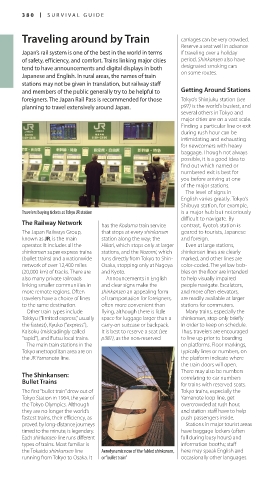
Travelers buying tickets at Tokyo JR station is a major hub but notoriously
difficult to navigate. By
The Railway Network has the Kodama train service contrast, Kyoto’s station is
The Japan Railways Group, that stops at every shinkansen geared to tourists, Japanese
known as JR, is the main station along the way; the and foreign.
operator. It includes all the Hikari, which stops only at larger Even at large stations,
shinkansen super express trains stations, and the Nozomi, which shinkansen lines are clearly
(bullet trains) and a nationwide runs directly from Tokyo to Shin- marked, and other lines are
network of over 12,400 miles Osaka, stopping only at Nagoya color-coded. The yellow bob-
(20,000 km) of tracks. There are and Kyoto. bles on the floor are intended
also many private railroads Announcements in English to help visually impaired
linking smaller communities in and clear signs make the people navigate. Escalators,
more remote regions. Often shinkansen an appealing form and more often elevators,
trav elers have a choice of lines of transportation for foreign ers, are readily available at larger
to the same destination. often more convenient than stations for commuters.
Other train types include flying, although there is little Many trains, especially the
Tokkyu (“limited express,” usually space for luggage larger than a shinkansen, stop only briefly
the fastest), Kyuko (“express”), carry-on suitcase or backpack. in order to keep on schedule.
Kaisoku (misleadingly called It is best to reserve a seat (see Thus, travelers are encouraged
“rapid”), and Futsu local trains. p381), as the non-reserved to line up prior to boarding
The main train stations in the on platforms. Floor markings,
Tokyo metropolitan area are on typically lines or numbers, on
the JR Yamanote line. the platform indicate where
the train doors will open.
There may also be numbers
The Shinkansen: correlating to car numbers
Bullet Trains for trains with reserved seats.
The first “bullet train” drew out of Tokyo trains, especially the
Tokyo Station in 1964, the year of Yamanote loop line, get
the Tokyo Olympics. Although overcrowded at rush hour,
they are no longer the world’s and station staff have to help
fastest trains, their efficiency, as push passengers inside.
proved by long-distance journeys Stations in major tourist areas
timed to the minute, is legendary. have baggage lockers (often
Each shinkansen line runs different full during busy hours) and
types of trains. Most familiar is information booths; staff
the Tokaido shinkansen line Aerodynamic nose of the fabled shinkansen, here may speak English and
running from Tokyo to Osaka. It or “bullet train” occasionally other languages.
380-381_EW_Japan.indd 380 08/08/16 3:10 pm

