


Page 384 - (DK Eyewitness) Travel Guide: Japan
P. 384
382 SUR VIV AL GUIDE
Traveling within Cities Shinbashi to Tokyo Teleport
Town in Odaiba (see pp106–7).
There are numerous systems of local transportation in the
major cities, all of which are efficient, safe, and clean. The Buses
only complication for foreigners is in the purchase of tickets:
systems vary from city to city; ticket machines tend to be Bus depots (basu noriba) are
often located outside of train
only in Japanese, except for train stations in cities; and few stations in cities. The method of
staff speak English. paying fares varies. Some buses
are boarded at the front, and the
Green Travel fare key on the machine and fare – often a flat rate – is
In one sense, travel in Japan’s insert the money. Change will deposited into a slot beside the
larger cities is already quite green be dispensed with the ticket. driver. If in doubt, state your
in that the superb pub lic trans If you are in any doubt about destination and offer the driver a
portation means people do not how much to pay, then simply selection of small coins to select
have such a great need to use buy the cheapest ticket and the correct amount. Exit from the
cars. Velo taxis (cycle rickshaw) pay the excess at the end. door in the middle of the bus.
are ecofriendly, and they have In Tokyo, the Pasmo and Suica A second system invites
started appearing in the more electronic card can be pur passengers to step aboard
touristy areas. Also in major cities, chased from vending machines toward the center or back of
a small number of regular taxis at many stations. Hold your card the bus; a machine distributes
now use hybrid cars, and these against the barriers at the numbered tickets. The num ber
are usually marked as such. station entrance to access the on this ticket appears on a screen
platform. These cards are valid at the front of the bus, which
on most forms of city transport. shows fares to be paid. If the
Subway
Station names are often ticket reads “2,” look along the
The Tokyo subway system displayed on platform sign line at the top of the screen and
(see inside back cover) is extensive boards in romanized (romaji) check the sum in yen below the
and colorcoded on maps to form as well as Japanese. corresponding figure. Before
match the color of the cars. All masstransit systems you disembark, drop the indi
Other cities, includ ing Osaka, close at around midnight cated amount and your ticket
Nagoya, Kobe, Sendai, Yokohama, until about 5am. into the box beside the driver.
Fukuoka, Kyoto, and Sapporo,
also have subway systems. Streetcars
Modes of operation differ slightly.
The JR Rail Pass (see p381) Streetcars still run in quite a
cannot be used on any subway few Japanese cities, including
system. Buy a ticket from either Hiroshima, Nagasaki, and
a vending machine or a ticket Sapporo. Tokyo has two
window. Subway ticket vending streetcar lines, and the Enoden
machines, are often only in Railway in Kamakura is also
Japanese. However, with a color classed as a streetcar. Fares and
coded transliter ated map, such systems for paying on streetcars
as the Tokyo subway system, differ from city to city; some
you can match the Japanese charge a flat fare irrespective
characters of your destination of the distance traveled. The Kagoshima sightseeing bus, a convenient
with those on the fare chart by fare machine is sometimes way of touring the city
the machine. The chart will show manned separately. Follow the Walking
in Arabic numerals how much to example of other passengers as
pay. Press the correspond ing to when to pay, and whether to Walking is a great way of
pay the fare collector or put exploring Japan’s cities. The city
money into the box. of Tokyo organizes free walking
tours for foreigners in various
languages. There are also a dozen
Monorail
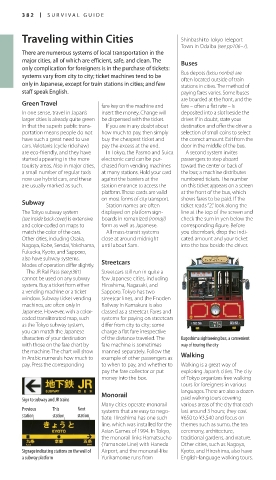
Sign to subway and JR trains paid walking tours covering
Many cities operate monorail various areas of the city that each
Previous This Next systems that are easy to nego last around 3 hours; they cost
station station station tiate. Hiroshima has one such ¥650 to ¥3,540 and focus on
line, which was installed for the themes such as sumo, the tea
Asian Games of 1994. In Tokyo, ceremony, architecture,
the monorail links Hamatsucho traditional gar dens, and nature.
(Yamanote Line) with Haneda Other cities, such as Nagoya,
Signage indicating stations on the wall of Airport, and the monoraillike Kyoto, and Hiroshima, also have
a subway platform Yurikamome runs from Englishlanguage walking tours.
382-383_EW_Japan.indd 382 08/08/16 3:10 pm
Eyewitness Travel LAYERS PRINTED:
Practical (transport) template “UK” LAYER
(Source v1.2)
Date 7th January 2013
Size 125mm x 217mm

