


Page 8 - (DK Eyewitness) Travel Guide: Japan
P. 8
6 HOW T O USE THIS GUIDE
HOW TO USE THIS GUIDE
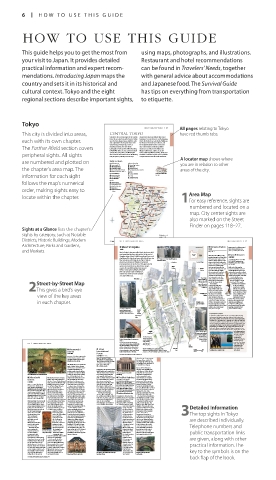
This guide helps you to get the most from using maps, photographs, and illus trations.
your visit to Japan. It provides detailed Restaurant and hotel recommendations
practical information and expert recom- can be found in Travelers’ Needs, together
mendations. Introducing Japan maps the with gen eral advice about accommodations
country and sets it in its historical and and Japanese food. The Survival Guide
cultural context. Tokyo and the eight has tips on everything from transportation
regional sections describe important sights, to etiquette.
Tokyo
T OK Y O AREA B Y AREA 69 All pages relating to Tokyo
This city is divided into areas, CENTRAL TOKYO have red thumb tabs.
Situated to the north and west of the Sumida department stores and affluent side-street
each with its own chapter. River, this area has been at the heart of Tokyo boutiques. For more down-to-earth shopping,
since the first shogun, Ieyasu, built his castle
there’s the Jinbocho area for books, Akihabara
and capital where the Imperial Palace still
for discount electronics and software, and
The Farther Afield section covers stands today. Destroyed by a series of the Tsukiji Fish Market for the catch of the
disasters, including the Great Kanto
day. Central Tokyo’s continuing politi cal
importance is evident in the Hibiya and
Earthquake of 1923 and the Allied bombing
in World War II, the area has reinven ted itself Marunouchi districts, and the area is also
several times over. Ginza and Nihonbashi
home to two very different shrines: Kanda and
peripheral sights. All sights were commercial centers and are still thriv ing Yasukuni. A selec tion of green spaces provides
a respite from the frenetic bustle elsewhere.
and prosperous, offering a mix of huge
are num bered and plotted on Sights at a Glance Parks and Gardens A locator map shows where
Notable Districts
1 Ginza see pp70–71 4 Hama-rikyu Gardens you are in relation to other
7 Nihonbashi District
the chapter’s area map. The 8 Marunouchi District w Kitanomaru Park areas of the city.
6 Shiba Park
t Koishikawa Korakuen Garden
r Jinbocho Booksellers’ District
u Akihabara Electronics District Markets
information for each sight Historic Buildings 3 Tsukiji Fish Market See also Street Finder maps
2 Kabuki-za Theater
3, 4, 5 & 6
River Trip
0 The Diet Building
q Imperial Palace 5 Sumida River Trip
follows the map’s numerical Shrines Korakuen BUNKYO-
e Yasukuni Shrine
y Kanda Myojin Shrine
Modern Architecture S O T O B O R I - D O R I Ochanomizu Suehirocho
order, making sights easy to 6 Tokyo Tower S O T O B O R I - D O R I Iidabashi EXPRESSWAY NO.5 Suidobashi Ochanomizu A I O I - Z A K A Akihabara Iwamotocho Asakusa- bashi Yanagibashi
9 Tokyo International
KU Suidobashi YUSHIMA-ZAKA
Forum
Shin
Ochanomizu
Kudanshita
locate within the chapter. YAS UK UN I - DORI Jinbocho HONGO-DORI Kanda Awajicho EXPRESSWAY NO.1 Bakurocho E D O - D O R I Bakuro- yokoyama Area Map
YASUKUNI-DORI
Takebashi 1For easy reference, sights are
EAST GARDEN CHUO-DORI Kodenmacho KIYOSUBASHI-DO Hamacho
OF THE
Hanzomon IMPERIAL PALACE Shin Nihonbashi Ningyocho RI I - D O R I
CHIYODA- H I B I YA - D O R I Otemachi EXPRESSWAY NO.9 S H I N - O H A S H numbered and located on a
Mitsukoshimae
KU UCHIBORI-DORI Tokyo EITAI-DORI Nihonbashi Suitengumae
U C H I B O
Nijubashimae CHUO-DORI Kayabacho
EXPRESSWAY NO.4 RI- D O R I SOTOBRI-DORI SHOWA - DORI map. City center sights are
Nagatacho
Sakuradamon Kyobashi Hatchobori
Hibiya Ginza-itchome KA JIBASHI-DORI
Kokkai- Yurakucho Takaracho
Gijidomae Kasumigaseki Ginza CHUO-KU also marked on the Street
EXPRESSWAY NO. 3 S A KURA D A-DORI Toranmon Uchisaiwaicho Shinbashi Higashi- ginza HANATSUBAKI-DORI Tsukijishijo Tsukiji Shintomicho S u m i d a R i v e r Finder on pages 118–27.
U C H I B O R I - D O R I
Roppongi-
H I B I YA - D O R I
itchome
H A R U M I - D O R I
Sights at a Glance lists the chapter’s Kamiyacho MINATO-KU H I N Shiodome
Onarimon
sights by category, such as Notable Akabanebashi Shibakoen Daimon D A I I C HI K E I Hamamatsucho 0 kilometers 0.5 1
0 miles
Districts, Historic Buildings, Modern Koishikawa Korakuen Garden in autumnY O AREA B Y AREA For keys to symbols see back flap WESTERN T OK Y O 97
EXPRESSWAY LOOP LINE
96 T OK
Architecture, Parks and Gardens, 2 West Shinjuku NORTHERN TOKYO 3 Shinjuku Station government forcibly removed
them; they settled in new
and Markets. Most of Tokyo’s skyscraper office blocks (and some of its Map 1 B1–2. Shinjuku Station
West Shinjuku
places, including Ueno Park.
most expensive land) are clustered just to the west of WESTERN CENTRAL 4 Sword Museum
Shinjuku station. About 250,000 people work here each TOKYO TOKYO With over two million people Sword Museum
passing through each day, this is
day. Many of the hotels and some office blocks have top- West Shinjuku seen from Tokyo Metropolitan the busiest train station in the
floor restaurants with views of the city. In 1960 the Government Offices world. As well as being a major 4-25-10 Yoyogi. Map 1 A3. Tel (03)
3379-1386. £ Sangubashi stn,
government designated Shinjuku a fukutoshin Island Tower Locator Map stop on both the JR and metro- Odakyu line. Open 10am–4:30pm
(“secondary heart of the city”); in 1991, when the city politan subway systems, Shinjuku Tue–Sun. &
government moved into architect Kenzo Tange’s Mitsui station is the starting point
massive 48-story Metropolitan Government Building Nomura for trains and buses into the A little out of the way, this
suburbs. On the Yamanote and
museum is full of fine Japanese
Offices, many started calling it shin toshin Building Chuo line platforms during swords dating back to the 12th
(the new capital). Tange’s building was the morning rush hour (from century. Like many other artifacts
dubbed “tax tower” by those outraged about 7:30 to 9am) staff are in Japan, swords combine art and
at its US$1 billion cost. employed to push those last ritual in the pursuit of perfection.
few commuters on to the
On the first floor is an
The Sonpo
Hilton Tokyo Japan Building, train, making sure the odd interesting display of the
body part isn’t slammed in
process by which a sword
Street-by-Street Map with its graceful one of the closing doors. is produced. The swords
curving base, is
one of the area’s
themselves are exhib ited
The corridors
on the second floor,
most distinctive connecting all the lines
2This gives a bird’s-eye K I T A - D O R I buildings. and train networks are every detail carefully
edged with hundreds of
refined, even down to
shops and restaurants. It’s
the pattern of burnishing
easy to lose your way in
on the blade’s face. There
view of the key areas H I G A S H I – D O R I Shinjuku Center this maze of seemingly Ornate sword history of the sword, and the
is also a display of deco-
Building
rated hilts. English
identical passages, and it is
handle
often simpler to find your
explanations trace the
bearings at ground level. For
in each chapter. Shinjuku station a time in the 1980s and early processes of tempering and
sharpening, handling, and
1990s, a substantial number of
home less (mostly men) built
and East Shinjuku
maintenance. Old Japanese
C H U O – D O R I G I J I D O – D O R I card board villages in the station’s texts, illustrated with beautiful
drawings, explain the finer
corridors. In a controversial
Sumitomo Building move, the municipal points of sword-making.
Inside this block are a Dai-Ichi
shopping center and, at Seimei
the top, a free observatory. Building Commuter Culture
Hyatt Regency K O E N – D O R I Commuters packed into trains are a common sight morning
Tokyo and evening at Tokyo’s major train stations. High urban land
prices force families to look farther out of the city for affordable
housing. As a consequence, a commute of at least an hour each
F U R E A I – D O R I way is practically the standard. By far the majority of commuters
are men, as they are still the prime earners in many families. The
commute effectively removes them from family life: they often
leave before the children get up, come back after they are in
bed, and collapse on weekends with fatigue. However, as two-
T O C H O – D O R I
income families become more the norm in Japan, there are also
Shinjuku Monolith Building increasing numbers
Central Park An imposing building, of women on trains.
An entire industry
as its name suggests,
around these
The Washington this block has a has developed
Hotel has flowing pleasant courtyard
Tokyo Metropolitan Government curves (inside and garden on the commuters: dozens
Offices out) and tiny north side. of magazines are
This huge complex of two blocks produced for killing
74 T OK Y O AREA B Y AREA and a semi-circular plaza is unified by windows in its time, and stand-up
CENTR AL T OK Y O 75
white façade.
the grid-detailing on its façades (see M I N A M I – D O R I KDDI restaurants offer
p92), recalling both traditional archi- Building cheap meals to
The NS Building is recognizable by its
8 Marunouchi 9 Tokyo tecture and electronic circuitry. An q Imperial Palace Keio Plaza Hotel 0 meters 100 Crowding onto a commuter train those with a long
ride ahead.
rainbow-hued elevator shafts. In the 30-story
observatory gives views from Mount
District International Fuji to Tokyo Bay on a clear day. atrium is a 29-m (95-ft) high water-powered clock. 0 yards 100
Imperial Palace
Marunouchi District Forum Map 3 A5, 3 B5, 5 A1, 5 B1.
For hotels and restaurants see p302 and pp324–6
Tokyo International Forum Nijubashi stn, Chiyoda line. £ Tokyo
Map 5 B1–2. Tokyo stn, Marunouchi stn, many lines. Imperial Palace:
line. £ Tokyo stn, many lines. Tokyo Map 5 B2. Tel (03) 5221-9000. Open Jan 2, Dec 23. East Garden of
City-i (info center): Open 8am–8pm Yurakucho stn, Yurakucho line; the Imperial Palace: Tel (03) 3213-
daily. ∑ en.tokyocity-i.jp Tokyo stn, Maru nouchi line. £ Tokyo 1111. Open 9am–4:30pm Tue–Thu,
This district lies to the south and and Yurakucho stns, many lines. Sat, Sun (Mar–Oct: to 5pm; Nov–Feb:
Open 7am–11:30pm daily.
to 4pm). ∑ kunaicho.go.jp
∑ t-i-forum.co.jp/en
west of Tokyo Station. During
the Edo era, it earned the name Ieyasu, the first Tokugawa
“Gambler’s Meadow” as its Designed by the American-based shogun, started building his
isolation made it an ideal place Rafael Viñoly, and completed in castle here in 1590. In the Edo
to gamble secretly. In the Meiji 1996, the Forum is one of down- The imposing granite exterior of the period his successors made
View of Mitsukoshi’s central hall in Nihonbashi period the army used it, selling town Tokyo’s most distinctive Diet Building this into the world’s largest
7 Nihonbashi Mitsukoshi, the Bank of Japan, it in 1890 to Mitsubishi. The and enjoyable buildings (see 0 The Diet Building castle; now only the inner
circle remains. The emperor
p29). A cultural center, it is made
arrival of the railway increased
and his family still live in the
District built in 1896 and modeled on the desirability of this barren up of two buildings: a curved, Hibiya District and the Diet Building
the Neo-Classical Berlin National wasteland as a business site,
Nihonbashi District glass atrium soaring 60 m Map 2 F3, 5 A2, 5 B2. Kokkai- western part of the grounds
Bank, was the first Western-style and after the 1923 earthquake, (200 ft), and a cube-like, white in the Imperial Palace, rebuilt
Map 5 C1–2, 6 D1. Tokyo stn, building designed by a Japan- many other firms moved here. structure housing four halls Gijidomae stn, Chiyoda & Marunouchi after the previous one was
lines; Hibiya stn, Toei Mita, Chiyoda &
Marunouchi line; Nihonbashi stn, ese architect, Kingo Tatsuno. Tokyo Station, designed by (the largest seating 5,012). A Hibiya lines. Hibiya Park: Open 24 bombed in World War II. Public
Ginza, Tozai & Toei Asakusa lines; On the north bank of Kingo Tatsuno and completed tree-shaded courtyard separates hours daily. Diet Building: Tel (03) access is allowed twice a year: at
Mitsukoshi mae stn, Ginza & Hanzomon Nihonbashi River, just before in 1914, is based on the design the two, while glass walkways 5521-7445. Open 8am–5pm Mon–Fri. New Year and on the emperor’s
lines. £ Tokyo stn, many lines. Tokyo Nihonbashi bridge, is the of Amsterdam station. Its dome provide an overhead link. 8 (compulsory, by reservation). birthday. The rest of the
Stock Exchange: Tel (050) 3377-7254. bronze marker from which was damaged in the 1945 air The interior of the huge ∑ sangiin.go.jp/eng/index.htm grounds, bounded by the moat,
Open 9am–4:30pm Mon–Fri. Mitsui distances to and from Tokyo raids and subsequently replaced atrium is filled with light and is divided into public parks.
Memorial Museum: Tel (03) 5777-8600. are still measured. The bridge by the polyhedron there today. has a ceiling resembling a ship’s Completed in 1936, the Diet The most famous landmark is
Open 10am–5pm Tue–Sun (open here today dates from 1911. The original reliefs adorning the hull. There are shops, cafés, and Building houses the legislature the Nijubashi, a double-arched
Mon if it is a national holiday). &
On the south bank of the river, domes above the north and restaurants, all supported by of the Japanese govern ment, stone bridge, east of the palace.
Nihonbashi was the mercan tile east of the bridge, is the Tokyo south exits are worth a look, state-of-the-art facilities original ly established as Completed in 1888, it was the
and entrepreneurial center of Stock Exchange, which lists as is the Tokyo Station Hotel. including high-speed Internet the Imperial Diet in the Meiji palace’s main en trance. The
Edo and Meiji Tokyo. Its name over 2,000 companies and is Opposite the station’s south access available in the lobby. era. Tours (in Japanese only) huge Otemon (Big Hand Gate),
means “Japan’s bridge” after the one of the world’s top five. gate is the shopping mall KITTE. cover the well-worn rebuilt in 1967, was the main
bridge over the Nihonbashi During the “bubble” economy A short walk west of the inside, including gate before Niju bashi was built. Detailed Information
River that marked the start of of 1980s, it was possible to station up Miyuki-dori and over the Diet chamber, Now it is the entrance to the
the five major highways watch the frenetic the moat via the Wadakura where you can see East Garden of the Imperial
of the Edo period. After hand signals of the bridge leads to the Wadakura the deliberations Palace. Just inside is
the destruction of the traders. In 1999 trading Fountain Park, which contains of Diet members, Sannomaru Shozo kan, a 3The top sights in Tokyo
1923 earthquake, was completely some interesting water features. and the extrava- collection of art and artifacts of
shops, businesses, computerized, but Returning over the Wadakura gantly decorated the Showa Emperor. Beyond is
and banks started this is still a great bridge, cross Hibiya-dori and rooms formerly used the Edo-era Hyaku nin Basho, are described individually.
relocating to place to see how turn right. After about 500 m by the emperor for where 100 samurai lived while
Marunouchi and Ginza; important commerce (550 yds) is the Meiji Seimei kan official functions. standing guard in shifts. Behind
even the fish market remains in Tokyo. Building (1934), with its huge Nearby is Central is the Honmaru, the castle’s
moved to Tsukiji. The visitors’ observa- Corinthian columns. Hiroshige, Tokyo’s only main keep, now just massive Telephone numbers and
Although the area tion deck overlooks the wood block print artist, was Western-style park, stone walls with good views
never regained its the trading floor born on this site in 1797. Beyond, Hibiya Park which from the top. To the east of
original importance, A robot trader exhibit, and has some the Imperial Theater shows is the focus of the the Honmaru is the restful
it is still a thriving Tokyo Stock Exchange interesting exhibits Broadway musicals and popular Hibiya district. Ninomaru garden, landscaped public transportation links
commercial center, comparing stock Japan ese dramas. The park’s location, by shogun Iemitsu in 1630.
with dozens of bank markets world wide, with English close to the
headquarters as well as huge and French explanations. political centers
department stores and smaller On the north side of the of Kasumigaseki are given, along with other
traditional shops. Mitsukoshi river near the Mitsukoshi and the Diet
has its main store here, on store is the Mitsui Memorial Building, makes it
Mitsukoshimae. It started as a Museum, which has an excel- a favorite place for practical information. The
kimono shop in 1673. Head for lent collec tion of Japanese public protests,
the basement food market with ceramics and teaware. Next to especially on May
its free samples, and the sixth- Nihonbashi station is Coredo Day. The large
floor bargain counters where Nihonbashi, an upmarket bandstand is also key to the symbols is on the
you can jostle with Tokyo’s shopping mall with a focus The airy glass-and-metal interior of the Tokyo occasionally used A glimpse of the Imperial Palace
thrifty elite. To the west of on women’s fashion. Tokyo Station’s Western-style facade International Forum for concerts. over Nijubashi
back flap of the book.
For hotels and restaurants see p302 and pp324–6
006-007_EW_Japan.indd 6 08/08/16 2:53 pm
Eyewitness Travel LAYERS PRINTED:
How to use this book (Source v1.2) “UK” LAYER
Date 5th November 2012
Size 125mm x 217mm

