


Page 9 - (DK Eyewitness) Travel Guide: Japan
P. 9
HOW T O USE THIS GUIDE 7
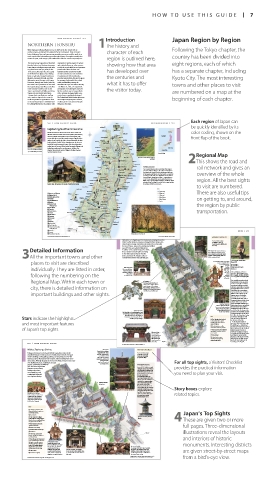
Introduction Japan Region by Region
JAP AN REGION B Y REGION 265
NORTHERN HONSHU 1The history and
When haiku poet Matsuo Basho set out in 1689 on his five-month trek to Following the Tokyo chapter, the
northern Japan, he likened it to going to the back of beyond. Three centuries character of each
later, shinkansen lines and expressways provide easy access, and the north is as
much a part of the information age as the rest of Japan. The region nevertheless country has been divided into
retains its quiet, rural image, a place where life is lived at a more congenial pace. region is outlined here,
The backcountry reputation of Northern vegetables in spring, oys ters in winter, showing how that area eight regions, each of which
Honshu belies its rich history. Long ago, and seafood all year are other reasons
it was home to indigenous people, who to visit the north, while its cool sum mers
may have been Ainu (see p291). In the provide relief from the heat and has developed over has a separate chapter, including
12th century, Hiraizumi was the capital humidity farther south. The wealth
of the Northern Fujiwara clan, rival ing of crafts and folk arts, such as Nanbu
Kyoto in splendor. During feudal times, testsubin (iron ket tles) in Morioka, the centuries and
Morioka, Tsuruoka, Hirosaki, and Aizu- wooden kokeshi dolls, Aizu and Tsugaru Kyoto City. The most interesting
Wakamatsu were thriving castle towns. lacquerware, kabazaiku (cherry-bark
Foremost, though, was Sendai, ruled by craft), and Mashiko pottery, are what it has to offer
the north’s most powerful clan and now renowned in Japan and internationally. towns and other places to visit
the region’s largest city. These and other On March 11, 2011, a 9-magnitude
north-country won ders, such as the earth quake and subse quent tsunami the visitor today.
shrines and temples of Nikko and Dewa hit this northern part of Japan. Much are numbered on a map at the
Sanzan, are now tourist attractions. of the area was damaged with some
Known for its excellent rice and fine coastal areas completely destroyed.
sake, northern Japan is the country’s The Fukushima Daiichi nuclear plant was beginning of each chapter.
main rice-producer. Agri culture is now also badly damaged by the tsunami,
mechanized, but farmers still work hard resulting in the evacuation of people
for a liv ing. Mushrooms in autumn, wild living near the plant.
Each region of Japan can
266 JAP AN REGION B Y REGION NOR THERN HONSHU 267
Oma
SHIMOKITA be quickly identified by its
PENINSULA
Exploring Northern Honshu Hokkaido Mutsu
Minmaya Wakinosawa
Northern Honshu is much more rural than Central and Rokkasho SAPPORO color coding, shown on the
Western Honshu. Snow-covered mountains, thick forests, Hiranai Sea of Japan
and rice paddies characterize most of the region, with Goshogawara AOMORI Noheji (East Sea) front flap of the book.
towns and ski resorts fairly evenly scattered. North of the
major city of Sendai, tiny pine-covered islands lie in calm Fukaura Iwaki-san 1,625 m AOMORI Misawa
bays facing the Pacific Ocean, forming some of the most HIROSAKI TOKYO
beautiful coastal scenery in Japan. The six northeastern Hachinohe OSAKA KYOTO
prefectures of Aomori, Akita, Iwate, Yamagata, Miyagi, and Taneichi
Fukushima make up the area known as Tohoku. This
One of the extravagant carvings by the Yomeimon gate at Nikko’s Tosho-gu Shrine Hachimori Noshiro Takanosu Odate TOWADA-HACHIMANTAI Ninohe Kuji KAGOSHIMA Pacific Ocean
chapter also includes parts of Niigata, Tochigi, Gunma,
A red torii shrine gate on an island in Matsushima Bay NATIONAL PARK
and Ibaraki prefectures.
PENINSULA OGA AKITA Kuzumaki Fudai Locator Map
Gojome Regional Map
Oga Moriyoshi-yama Iwate-san Clear waters and the rugged coastline of
1,454 m Iwaizumi
Akita 2,041 m Sado Island
KAKUNODATE MORIOKA Miyako 2This shows the road and
Omagari IWATE Yamada Todoga-saki
Honjo HANAMAKI Getting Around rail network and gives an
Yokote TONO Two main shinkansen lines penetrate this region:
Kisakata Ou-sanmyaku Kitakami Kamaishi one from Tokyo to Niigata, the other from Tokyo to
Tobi-shima Mizusawa Hachinohe via Sendai. Branch shinkansen lines run
Chokai-san Ogachi Ofunato overview of the whole
2,237 m to Yamagata and Akita. From Hachinohe, a main line
HIRAIZUMI Rikuzen-Takata continues north and on to Hokkaido via the Seikan
Sakata Kaneyama Ichinoseki Kesennuma Tunnel. Much slower branch lines – some private –
DEWA SANZAN serve towns along both coasts and in the interior.
TSURUOKA Shinjo Nikko is an easy day trip from Tokyo; elsewhere allow region. All the best sights
Atsumi Obanazawa TOBOKU EXPRESSWAY Shizugawa plenty of time for travel. A rental car is a good option
A kabuto-zukuri-style farmhouse in the grounds of Chido Museum, Tsuruoka YAMAGATA TOBOKU SHINKANSEN MIYAGI for getting off the beaten track.
Sanpoku
Awa-shima Tendo Ishinomaki to visit are numbered.
MATSUSHIMA
Hajiki-zaki Key
Murakami Yamagata Natori SENDAI Expressway There are also useful tips
Sights at a Glance Aikawa Ryotsu Arakawa Iide-san NATIONAL PARK BANDAI-ASAHI Nanyo Major road
1 Nikko pp268–75 Shibata Iwanuma Other road
2 Nikko National Park Niigata Yonezawa Main Railway
3 Mashiko Ogi SADO Minor Railway on getting to, and around,
4 Aizu Wakamatsu ISLAND Shirone Niitsu 2105 m KITAKATA Fukushima Soma Border
5 Kitakata Haramachi
6 Bandai-Asahi BANETSU EXPRESSWAY Nihonmatsu the region by public
National Park NIIGATA
7 Sado Island Nagaoka Koriyama Otakine-yama Namie
8 Tsuruoka Kashiwazaki AIZU WAKAMATSU 1193 m
9 Dewa Sanzan Ojiya FUKUSHIMA Sukagawa Tomioka transportation.
0 Sendai Itoigawa Koide Tajima Ishikawa
JOETSU SHINKAUSEN
q Matsushima Joetsu Shirakawa
w Hiraizumi Muika NIKKO TOBOKU EXPRESSWAY Iwaki
e Hanamaki Hiuchiga-take 2346 m NATIONAL Kuroiso
r Tono PARK
t Morioka Mikuni-toge Shirane-san 2578 m Yaita Daigo Kitaibaraki
1244 m
y Kakunodate NIKKO Takahagi
u Oga Peninsula TOCHIGI
i Towada-Hachimantai Maebashi Utsunomiya MASHIKO
National Park 0 kilometers 50 Tokyo Katsuta
o Hirosaki 0 miles 30 Oyama Kasama 274 JAP AN REGION B Y REGION NIKK O 275
p Aomori Shimodate Mito
a Shimokita Peninsula IBARAKI Weeping cherry trees in Hirosaki
For hotels and restaurants see p307 and pp337–8 Nikko: Taiyuin-byo Shrine For keys to symbols see back flap VISITORS’ CHECKLIST
Finished in 1653, Taiyuin-byo is the mauso leum of Tokugawa Iemitsu Practical Information
(1604–51), the grandson of Ieyasu and powerful third shogun, who Tel (0288) 53-1567. &
closed Japan to foreign com merce and isolated it from the world Open 8am–5pm daily (to 4pm
for over 200 years. Tayuin is his posthumous Buddhist Nov–Mar).
Detailed Information is sublime. Set in a grove of Japanese cedars, Bell Tower This structure forms a
name. If Tosho-gu is splendid, Taiyuin-byo
it has a number of ornate gates ascending
pair with the drum tower. They
3All the important towns and other to the Haiden (sanctuary) and Honden are no longer used, but the drum
signifies positive/birth, while the
(inner sanctuary). The shogun’s ashes are
bell is negative/death.
entombed beyond the sixth and final gate.
places to visit are described . Nitenmon Gate Four guardian A monkey by the roadside, Nikko
National Park
statues occupy the niches
here. At the front are
the gods 2 Nikko
Komoku
individually. They are listed in order, This unusual Ming- while at the National Park Nikko National Park
Kokamon Gate
and Jikoku,
dynasty Chinese-
style gate is beside back are Tochigi, Fukushima, and Gunma
the green
following the numbering on the Iemitsu’s tomb. the red god prefectures. @ from Nikko stations.
god of
the path to
n 3-4 Namiki-cho, Nikko-shi (0288)
wind and
22-1525. ∑ nikko-travel.jp/english
of thunder.
Regional Map. Within each town or . Haiden The magnificent national park
that includes Tosho-gu and its
Decorated with carvings of
dragons, the Haiden also has environs is largely a mountain-
ous volcanic plateau, studded
city, there is detailed information on some famous 17th-century with lakes, waterfalls, hot springs,
lion paint ings by Kano School
and swamplands. For a taste of
painters. Its exterior is decorated
with black and gold lacquer. Oku-Nikko, the mountainous
important buildings and other sights. interior, take the bus west from
Nikko to Lake Chuzen-ji. The
hairpin curves of Irohazaka,
along the old ascent to the
sacred Mount Nantai, start at
Umagaeshi (horse return), where
pilgrims had to give up their
Granite Fountain horses and walk. Halfway up, at
On the ceiling above the Akechidaira, there is an excellent
basin is a dragon painting view of Mount Nantai, which
by Kano Yasunobu, which dominates the lake. At the east
Yashamon Gate is sometimes reflected end of the lake, the Kegon Falls,
The third gate is beautifully gilded and in the water below. named for the Buddhist principle
of uni versal unity, cascade 96 m
contains four statues of Yasha, a fierce (315 ft) to the Daiya River below.
guardian spirit. It is also known as
Stars indicate the highlights Botanmon, or peony gate, after its KEY 1 The Honden (usually closed An elevator through the cliff
detailed peony carvings.
runs to an observation deck
at the base of the falls.
Buddhist altar with a wooden
and most important features to the public) holds a gilded At the nearby temple of
Chuzen-ji, the main image is the
statue of Iemitsu.
Tachiki Kannon, a 1,000-armed
of Japan’s top sights. 2 The Ai No Ma is a richly Kannon said to have been carved
decorated connecting chamber.
from a live tree by Shodo Shoin,
Nikko’s founder. On July 31
3 The Karamon gate is adorned
Niomon Gate with delicate carvings, such as a hundreds of pilgrims make an
pair of cranes.
This marks the overnight climb of Mount Nantai,
main entrance to 4 Drum Tower reach ing the top by sunrise.
the shrine. One 5 Stone lanterns were Yumoto, a lakeside onsen town,
Nio warrior god donated over the years by linked by bus to Nikko station
stands guard on daimyo (feudal lords). and Lake Chuzen-ji, is one of
each side. Entrance several spas in the park.
270 JAP AN REGION B Y REGION NIKK O 271
For hotels and restaurants see p307 and pp337–8
Nikko: Tosho-gu Shrine Donated by a daimyo VISITORS’ CHECKLIST
. Pagoda
Tokugawa Iemitsu set out to dazzle with this mausoleum-shrine for his (feudal lord) in 1650, Practical Information
grandfather Ieyasu. For two years some 15,000 artisans from all over Japan this five-story pagoda Tel (0288) 54-0560. &
was rebuilt in 1818
worked, building, carving, gilting, painting, and lacquering, to create this after a fire. Each story Open 8am–5pm daily
(to 4pm Nov–Mar).
flowery, gorgeous Momoyama-style complex. Almost anything that can be represents an element
decorated is. Although designated a shrine in the Meiji period, it retains many – earth, water, fire, For all top sights, a Visitors’ Checklist
of its Buddhist elements, including its unusual wind, and heaven in
pagoda, sutra library, and Niomon ascending order. Tokugawa Ieyasu
gate. The famed sugi-namiki Ieyasu (1543–1616) was a wily provides the practical information
(Japanese cedar avenue) strategist and master politician
leading to the shrine who founded the dynasty that
was planted by a 17th- would rule Japan for over 250 you need to plan your visit.
years. Born the son of a minor
century lord, in lieu of a lord, he spent his life
more opulent offering. accumulating power, not
becoming shogun until 1603,
when he was 60. He built his
capital at the swampy village
To Ieyasu’s Tomb and of Edo (now Tokyo), and his
Treasure Tower rule saw the start of the
flowering of Edo culture. He
ensured that after his death, he Story boxes explore
would be enshrined as a god
and gongen (incarnation of the
Buddha). His posthumous
Sleeping Cat Carving name was Tosho-Daigongen related topics.
Over an entrance in the east (the great incar-nation
corridor, this tiny, exquisite illuminating the East).
carving of a sleeping cat is
attributed to Hidari Jingoro
(Left-handed Jingoro).
KEY
1 The Rinzo contains a sutra
library of Buddhist scriptures in
a revolving structure. Japan’s Top Sights
2 Drum tower
3 The Honji-do’s ceiling is leyasu’s treasure tower, containing
painted with the “crying dragon,” his ashes 4 These are given two or more
which echoes resoundingly if you
clap your hands beneath it.
4 The Karamon gate is the
smallest at Tosho-gu. full pages. Three-dimensional
5 Haiden (sanctuary)
6 Honden (inner sanctuary)
7 Bell tower Entrance illustrations reveal the layouts
8 The three sacred store-
houses are built according to a
traditional design.
9 The Niomon (or Omotemon) and interiors of historic
gate is guarded by two fear some
Nio figures, one with an open . Yomeimon Gate
mouth to pronounce the first Lavishly decorated with monuments. Interesting districts
letter of the Sanskrit alphabet beasts and flowers, this gate
(ah), the other with a closed has one of its 12 columns . Sacred Stable
mouth for the last letter (un). carved upside-down, a A carving of the three wise monkeys
0 Ticket office deliberate imperfection Sacred Fountain The granite decorates this unpainted wooden are given street-by-street maps
to avoid angering jealous
basin (1618), for ritual purification,
building. A horse given by the New
q Granite Torri (gate) spirits. Statues of imperial is covered with an ornate Chinese- Zealand government is stabled here
ministers occupy the niches. style roof. for several hours a day.
A Shinto priestess sweeping under the Yomeimon gate from a bird’s-eye view.
For hotels and restaurants see pp302–307 and pp324–339
006-007_EW_Japan.indd 7 08/08/16 2:53 pm

