


Page 20 - All About History - Issue 34-16
P. 20
THE

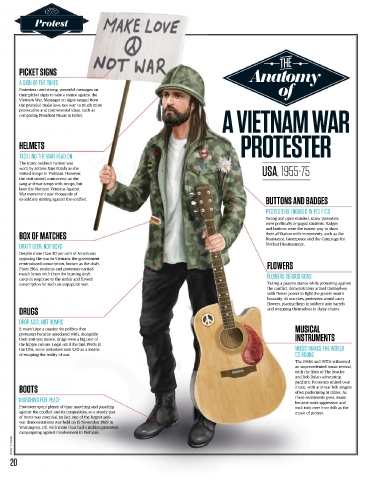
        PICKETSIGNS                                                                      Anatomy

        A SIGN OF THE TIMES
        Protesters used strong, powerful messages on                                               of
        their picket signs to take a stance against the
        Vietnam War. Messages on signs ranged from
        the peaceful ‘make love, not war’ to much more
                                                                               AVIETNAMWAR
        provocative and controversial ideas, such as
        comparing President Nixon to Hitler.


        HELMETS                                                                       PROTESTER

        TACKLING THE WAR HEAD ON
        The iconic soldier’s helmet was
        worn by actress Jane Fonda as she                                                    USA, 1955 75
        visited troops in Vietnam. However,
        the visit stirred controversy as she
        sang anti-war songs with troops, but
        later the Vietnam Veterans Against
        War movement saw thousands of
                                                                                              BUTTONSANDBADGES
        ex-soldiers uniting against the conflict.
                                                                                              PROTESTERS ENGAGED IN POLITICS
                                                                                              Young and open minded, many protesters
                                                                                              were politically engaged students. Badges
                                                                                              and buttons were the easiest way to show
        BOXOFMATCHES                                                                          their affiliation with movements, such as the
                                                                                              Resistance, Greenpeace and the Campaign for
        DRAFT BEER, NOT BOYS                                                                  Nuclear Disarmament.
        Despite more than 50 per cent of Americans
        opposing the war in Vietnam, the government
        reintroduced conscription, known as the draft.                                         FLOWERS
        From 1964, students and protesters carried
        match boxes with them for burning draft                                                FLOWERS VERSUS GUNS
        cards in response to the unfair and flawed
        conscription for such an unpopular war.                                                Taking a passive stance while protesting against
                                                                                               the conflict, demonstrators armed themselves
                                                                                               with flower power to fight the government’s
                                                                                               brutality. At marches, protesters would carry
                                                                                               flowers, placing them in soldiers’ gun barrels
        DRUGS                                                                                  and wrapping themselves in daisy chains.

        DROP ACID, NOT BOMBS
        It wasn’t just a passion for politics that                                                       MUSICAL
        protesters became associated with. Alongside
        their anti-war stance, drugs were a big part of                                                  INSTRUMENTS
        the hippie culture. Legal until the mid-1960s in
        the USA, some protesters took LSD as a means                                                     MUSIC MAKES THE WORLD
        of escaping the reality of war.                                                                  GO ROUND
                                                                                                         The 1960s and 1970s witnessed
                                                                                                         an unprecedented music revival,
                                                                                                         with the likes of The Beatles
                                                                                                         and Bob Dylan advocating
                                                                                                         pacifism. Protesters united over
        BOOTS                                                                                            music, with anti-war folk singers
                                                                                                         often performing at rallies. As
        MARCHING FOR PEACE                                                                               these sentiments grew, music
                                                                                                         became more aggressive, and
        Protesters spent plenty of time marching and parading                                            rock took over from folk as the
        against the conflict and its inequalities, so a sturdy pair                                      music of protest.
        of boots was essential. In fact, one of the largest anti-
        war demonstrations was held on 15 November 1969 in
        Washington, DC, with more than half a million protesters
        campaigning against involvement in Vietnam.
     © Kevin McGivern


     20

