


Page 23 - All About History - Issue 34-16
P. 23
Protest


                                                                                       DODGE OFFICIALS

                                                                                       Gandhi prepared himself and his followers for
                                                                                       arrest, but it never came. There was no significant
                                                                                       British presence on the march until after it had
                                                                                       been completed. As a result, Gandhi’s ‘satyagraha’
                                                                                       nonviolent resistance continued on, and it became
                                                                                       so effective that it rallied Indians from all across
                                                                                       the subcontinent to the cause, including those of
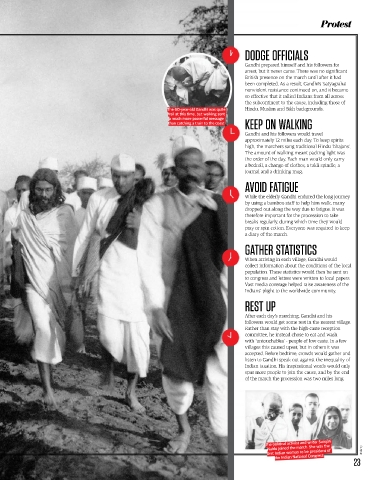
                                                            The 60-year-old Gandhi was quite   Hindu, Muslim and Sikh backgrounds.
                                                            frail at this time, but walking sent
                                                            a much more powerful message
                                                                                       KEEP ON WALKING
                                                            than catching a train to the coast
                                                                                       Gandhi and his followers would travel
                                                                                       approximately 12 miles each day. To keep spirits
                                                                                       high, the marchers sang traditional Hindu ‘bhajans’.
                                                                                       The amount of walking meant packing light was
                                                                                       the order of the day. Each man would only carry
                                                                                       a bedroll, a change of clothes, a takli spindle, a
                                                                                       journal and a drinking mug.

                                                                                       AVOID FATIGUE

                                                                                       While the elderly Gandhi endured the long journey
                                                                                       by using a bamboo staff to help him walk, many
                                                                                       dropped out along the way due to fatigue. It was
                                                                                       therefore important for the procession to take
                                                                                       breaks regularly, during which time they would
                                                                                       pray or spin cotton. Everyone was required to keep
                                                                                       a diary of the march.
                                                                                       GATHER STATISTICS

                                                                                       When arriving in each village, Gandhi would
                                                                                       collect information about the conditions of the local
                                                                                       population. These statistics would then be sent on
                                                                                       to congress and letters were written to local papers.
                                                                                       Vast media coverage helped raise awareness of the
                                                                                       Indians’ plight to the worldwide community.

                                                                                       REST UP

                                                                                       After each day’s marching, Gandhi and his
                                                                                       followers would get some rest in the nearest village.
                                                                                       Rather than stay with the high-caste reception
                                                                                       committee, he instead chose to eat and wash
                                                                                       with ‘untouchables’ - people of low caste. In a few
                                                                                       villages this caused upset, but in others it was
                                                                                       accepted. Before bedtime, crowds would gather and
                                                                                       listen to Gandhi speak out against the inequality of
                                                                                       Indian taxation. His inspirational words would only
                                                                                       spur more people to join the cause, and by the end
                                                                                       of the march the procession was two miles long.


                                                                                              The political activist and writer Sarojini
                                                                                               Naidu joined the march. She was the
                                                                                               first Indian woman to be president of   © Alamy
                                                                                                 the Indian National Congress
                                                                                                                             23

